NFL Betting Mistakes: The Errors That Cost UK Punters the Most
 Available in US

My first NFL betting season was a masterclass in every mistake this article describes. I chased losses on Monday night after a bad Sunday. I loaded up on ten-leg accumulators because the potential payout looked irresistible. I bet on teams because I liked their quarterback rather than because the line offered value. By February, I’d burned through my entire season bankroll plus money I shouldn’t have been betting with. That experience — expensive, humbling, and entirely avoidable — is the reason I now approach NFL betting as a discipline rather than entertainment.
The UK betting market handles roughly 290 million online wagers per month, and a significant portion of that volume comes from bettors repeating the same mistakes season after season. The errors below aren’t theoretical. They’re patterns I’ve observed in my own betting, in conversations with fellow punters, and in the systematic data that shows how recreational bettors lose money. Approximately 2.7% of UK adults — around 1.4 million people — experience problem gambling, and while most NFL bettors won’t reach that threshold, the same cognitive biases that fuel problem gambling also erode recreational bankrolls through poor decision-making.
Betting with Your Eyes Instead of the Numbers
The most expensive mistake in NFL betting is confusing what you saw with what actually happened. You watch a team dominate for three quarters, then collapse in the fourth and lose by three. Your emotional takeaway: that team is good, they just got unlucky. Your analytical takeaway should be different: why did they collapse? Was the defensive line exhausted from a lopsided time-of-possession battle? Did the offensive play-calling become predictable? Was the fourth-quarter failure a fluke or a pattern?
Recency bias is the most destructive cognitive bias in NFL betting. The game you watched most recently dominates your perception of a team, even though it’s one data point in a 17-game season. A team that lost 38-10 last week feels worse than a team that lost 17-14, even if the team that lost by 28 faced a far superior opponent and the result was predictable. I combat recency bias by waiting 24 hours after watching games before making any betting decisions for the following week. The emotional residue of Sunday’s results fades, and my analysis becomes clearer.
Fan bias is its quieter cousin. UK bettors who support an NFL team — and with 14.3 million NFL followers in Britain, that’s a significant number — consistently overrate their own team’s chances. The emotional investment that makes fandom enjoyable makes betting analysis unreliable. I have a hard rule: I never bet on or against my own team. The line might occasionally offer value, but my inability to assess it objectively means I’m better off sitting those games out entirely.
Accumulator Addiction and the Parlay Trap
Keith Whyte, executive director of the National Council on Problem Gambling, has observed that more respondents now believe gambling is a good way to make money and frequently rely on it for daily expenses. That belief is most dangerous in the context of accumulators, where the headline payout creates an illusion of achievable wealth that the mathematics firmly contradicts.
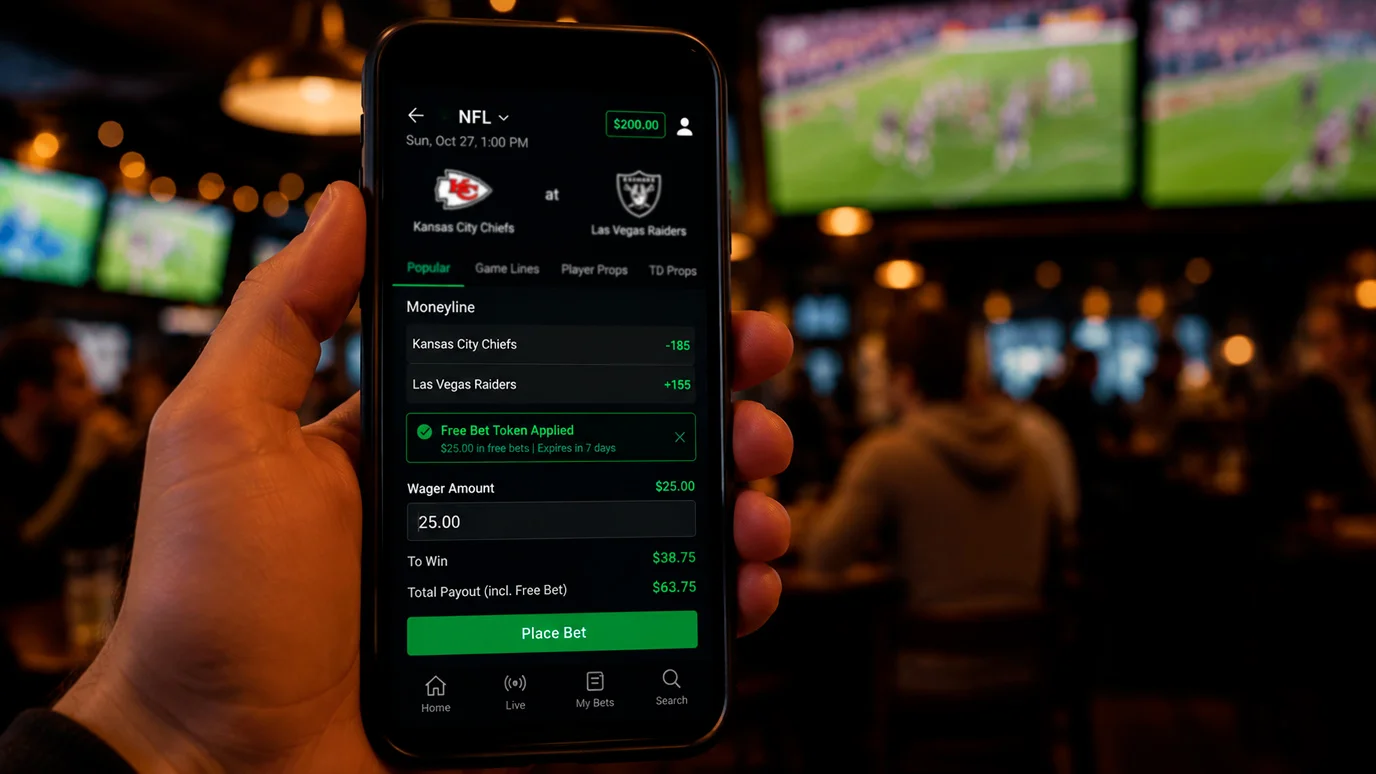
A five-leg NFL accumulator at even money on each leg has a 3.1% probability of winning. That means 97 out of 100 attempts will lose your stake entirely. The market knows this — accumulators are the single most profitable product for sportsbooks, which is exactly why they’re promoted so aggressively with insurance offers, boost tokens, and social media celebrations of big acca wins. You see the one winner. You don’t see the ninety-seven losses that funded it.
I’m not anti-accumulator. Used strategically with small stakes and correlated legs, parlays have a role in a disciplined betting portfolio. But they should represent no more than 10% of your total weekly stakes, and each leg should be a bet you’d place as a single. If you’re adding legs to reach an insurance threshold or because the combined payout “looks right,” you’ve already lost the strategic battle. The gap between entertainment-motivated acca building and value-driven parlay construction is the gap between losing money and managing it.
Ignoring Line Movement and Market Signals
The line moves for a reason. When a spread shifts from -3 to -4.5 between Tuesday and Sunday, that movement tells you that significant money — usually sharp money — has landed on one side. Ignoring line movement is like ignoring the weather forecast before a picnic. The information is free, publicly available, and directly relevant to your decision.
Reverse line movement is even more informative. When 75% of public bets are on Team A but the line moves in favour of Team B, the sportsbook is telling you that the money (not the number of bets) is on Team B. Sharp bettors placed larger wagers on the less popular side, and the sportsbook adjusted accordingly. Fading the public and following reverse line movement is one of the oldest edges in sports betting, and it works in NFL markets because the public’s biases are predictable and persistent.
The mistake isn’t just ignoring line movement — it’s betting into a moving line without understanding why it moved. If you liked a team at -3 and the line moves to -4.5, you’re now getting a worse price. Did the line move because of sharp money that knows something you don’t? Or did it move because a star player was ruled out and the public overreacted? The answer determines whether the new price is still valuable or whether the market has correctly adjusted away from your edge.
Poor Bankroll Discipline and Chasing Losses
Every bankroll management system works. The one that fails is the one you abandon after a losing week. I’ve watched disciplined bettors lose three consecutive Sundays, panic, double their stakes on Monday night, and wipe out two months of profit in a single game. The emotional spiral — I need to get even, this is a lock, I’ll just bet bigger this once — is the most reliable path to a depleted bankroll in all of sports betting.
Flat betting — wagering the same amount on every bet — is the simplest and most resilient bankroll approach for NFL bettors. One to two percent of your total bankroll per bet means that a losing streak of ten consecutive bets (which happens to every bettor eventually) costs you 10-20% of your bankroll rather than destroying it. You need your bankroll to survive losing streaks, because the edge in NFL betting is small — 53-55% hit rate for a profitable bettor — and variance will produce extended runs of losses even when your process is sound.
I track every bet in a spreadsheet with the date, game, bet type, odds, stake, and result. This record serves two purposes: it forces accountability (you can’t lie to yourself about your results when the numbers are in front of you) and it enables analysis of your betting patterns. After my first full season of tracking, I discovered that my live bets were destroying my overall ROI while my pre-match spread bets were solidly profitable. Without the data, I’d have continued bleeding money on live bets indefinitely, and my bankroll management strategy would have been fighting a losing battle against a leak I didn’t know existed.
Treating NFL Betting as a Sprint Instead of a Season
The NFL regular season runs 18 weeks. Add the preseason, playoffs, and Super Bowl, and you have roughly six months of betting opportunities. Yet most recreational bettors approach each week as an isolated event, making decisions without reference to their season-long performance, bankroll trajectory, or evolving understanding of teams. This week-to-week mindset leads to overreaction, inconsistency, and the kind of emotional volatility that professional bettors have trained themselves to eliminate.
The best NFL bettors I know treat the season as a single, continuous project. They establish a process in August, refine it through September, and execute it consistently from October through February. Bad weeks don’t change the process. Good weeks don’t inflate the stakes. The approach remains constant because the edge is in the process, not in any individual bet. A 54% ATS rate across 200 bets produces reliable profit. A 70% rate across 10 bets means nothing — the sample is too small to distinguish skill from luck.
If you take one thing from this article, make it this: the goal of NFL betting isn’t to win today. It’s to be profitable in May when you add up every bet you’ve placed since September. Every decision you make between now and then should serve that long-term objective, not the short-term desire to celebrate a winner on Sunday evening.
What is the most common NFL betting mistake among UK bettors?
Recency bias — overweighting the most recently watched game when assessing a team’s quality. A single performance, whether dominant or disastrous, is one data point in a 17-game season. Waiting 24 hours before making betting decisions after watching games helps separate emotional reactions from analytical assessment.
Why do most NFL accumulator bettors lose money over time?
A five-leg accumulator at even money on each leg has a 3.1% win probability, meaning 97 out of 100 attempts lose the full stake. The compounding odds make large payouts possible but statistically improbable. Accumulators are the most profitable product for sportsbooks, which is why they receive the heaviest promotional support. Disciplined bettors limit accas to under 10% of weekly stakes.
Written by the editors at Online Sports Betting nfl.