NFL Odds and Lines Explained: A UK Punter’s Complete Guide
 Available in US
The first NFL line I ever saw at a UK bookmaker read “Kansas City Chiefs -3.5 (10/11).” I understood the fractional odds instantly — I had been betting football since I was old enough to have an account. But the minus sign, the half-point, and the relationship between the number and the price confused me in a way that Premier League betting never had. I placed the bet anyway, lost, and spent the next two hours figuring out what I had actually been backing.
That experience is common among UK bettors who cross over to NFL wagering. The sport uses a different numerical language than what British punters grow up with. American odds formats look alien. Spreads and totals carry meanings that do not map onto football handicaps as cleanly as you might expect. And the lines themselves — the numbers that bookmakers set and the market moves — follow patterns rooted in the specific scoring structure of American football.
This guide covers the entire chain: how NFL odds are constructed, how the three major odds formats translate between each other, what implied probability actually tells you about a line, how bookmakers set and adjust NFL numbers, and which specific numbers carry outsized significance in a sport where scores move in irregular increments. By the end, you should be able to read any NFL coupon at any UK sportsbook and understand precisely what you are being offered.
How NFL Odds Work
I spent a season betting NFL before I properly understood that odds are not predictions — they are prices. That single shift in framing changed how I approach every market. A bookmaker is not telling you that the Bills have a 65% chance of winning when they price them at 1/2. The bookmaker is offering you a price that reflects the combined weight of their opening model, the money that has landed on each side, and their built-in profit margin. Whether the true probability aligns with that price is your problem, not theirs.
NFL odds express the relationship between what you stake and what you stand to receive. Every NFL market — spreads, totals, moneylines, props, futures — carries odds that determine your payout. The odds also carry embedded information about how the market views the contest, which makes them a valuable analytical tool even if you never place a bet.
At UK sportsbooks, NFL odds are most commonly displayed in fractional format (the default for British bookmakers) or decimal format (increasingly popular among younger bettors and widely used across European platforms). American sportsbooks and media use a third format — the “moneyline” or “American” format — which you will encounter constantly if you follow NFL betting content from US sources. All three formats express the same underlying relationship. The numbers look different. The maths is identical.
The critical concept is the “vig” or “vigorish” — the bookmaker’s margin built into the odds. In a theoretically fair market with two equally likely outcomes, each side would be priced at evens (1/1 fractional, 2.00 decimal, +100 American). In reality, the bookmaker prices both sides below fair value — typically at 10/11 (1.91 decimal, -110 American) for a standard NFL spread market. The gap between the true probability and the implied probability in the odds is how the bookmaker earns revenue regardless of the outcome. The UK gambling industry generated 1,786 million pounds in gaming revenue between April and August 2025, up 9% year on year — a figure that reflects, in part, the steady accumulation of vigorish across millions of individual bets.
Fractional, Decimal, and American Odds Formats
Every autumn I field the same question from mates who have started watching NFL on Sky Sports: “What do the plus and minus signs mean?” It is the single biggest barrier for UK bettors engaging with American betting content, and it takes about five minutes to resolve permanently.
Fractional odds are home territory for British punters. 4/1 means you win four pounds for every one staked. 1/4 means you win one pound for every four staked. The numerator is your profit; the denominator is your stake. When a UK sportsbook lists an NFL moneyline favourite at 2/7, you win two pounds for every seven risked. Fractional odds make it immediately clear whether you are backing a favourite (denominator larger than numerator) or an underdog (numerator larger).
Decimal odds express the total return including your stake. Odds of 3.50 mean that a one-pound bet returns 3.50 total — 2.50 in profit plus your original pound. Converting from fractional to decimal is straightforward: divide the numerator by the denominator and add one. So 4/1 becomes (4 / 1) + 1 = 5.00. And 1/4 becomes (1 / 4) + 1 = 1.25. Decimal odds are mathematically cleaner for comparing prices across markets because the calculation is simpler: stake multiplied by decimal odds equals total return.
American odds use a baseline of 100 and split into positive and negative numbers. Positive odds (+200) tell you how much you win on a 100-unit stake: +200 means you win 200 on a 100 bet. Negative odds (-150) tell you how much you need to stake to win 100 units: -150 means you risk 150 to win 100. The crossover point is -100/+100, which is the American equivalent of evens.
Here is the same line in all three formats for a hypothetical NFL spread market:
Philadelphia Eagles -3.5: 10/11 fractional, 1.91 decimal, -110 American. Green Bay Packers +3.5: 10/11 fractional, 1.91 decimal, -110 American.
Both sides priced identically — the bookmaker’s standard spread pricing. If you see this price and think “the bookmaker has no opinion on which side wins,” you are right. The spread itself is the bookmaker’s opinion. The price is designed to attract roughly equal money on both sides.
Converting between formats becomes second nature with practice, but a useful shortcut is to anchor on one format and mentally translate. I think in decimal odds because the maths is simplest: multiply your stake by the decimal to get your total return. Most UK sportsbooks let you toggle between formats in your account settings, so choose whichever feels most intuitive and train your eye on that.
Implied Probability and Overround
The number that changed my entire approach to NFL betting was not a score, a spread, or a stat. It was a percentage. Specifically, it was the moment I calculated the implied probability of a line I was about to bet and realised the bookmaker’s price implied a 56% chance of an outcome I believed had a 62% chance of occurring. That six-point gap was the edge — and it was hiding in plain sight behind the fractional odds.
Implied probability converts odds into a percentage that represents how likely the outcome needs to be for the bet to break even. The formula for decimal odds is straightforward: 1 divided by the decimal odds, multiplied by 100. Odds of 1.91 produce an implied probability of 52.4%. Odds of 3.50 produce 28.6%. Odds of 1.25 produce 80%.
For fractional odds, the formula is: denominator divided by (numerator plus denominator), multiplied by 100. At 4/1, that gives you 1 / (4 + 1) = 20%. At 1/4, it gives you 4 / (1 + 4) = 80%. These percentages tell you the breakeven point — bet at 4/1 and you need to win more than 20% of the time to profit long-term.
Here is where the overround enters. In a two-outcome market (like an NFL spread), the two implied probabilities should sum to 100% if the odds are fair. They never do. A standard NFL spread market priced at 10/11 on both sides produces implied probabilities of 52.4% + 52.4% = 104.8%. That extra 4.8% is the overround — the bookmaker’s built-in edge. The American football betting market alone is projected to reach $9.5 billion in 2026, growing at 11.5% annually, and the overround is the mechanism that makes this revenue possible.
Overrounds vary by market and by bookmaker. Main NFL spreads and totals typically carry a 4-5% overround at UK sportsbooks. Player prop markets carry 6-10% or more, because the pricing models are less precise and the bookmaker needs a wider margin to compensate. Futures markets can carry overrounds of 15-30%, particularly early in the season when the field includes 32 teams.
Why does this matter practically? Because when you compare odds between sportsbooks, you are not just looking for the highest number. You are looking for the line where the implied probability is furthest below your own assessed probability of the outcome. A bet at 2.00 (implied 50%) is better value than a bet at 2.10 (implied 47.6%) only if you believe the true probability is below 50%. If you think the true probability is 45%, the 2.10 line gives you more edge. Thinking in implied probabilities rather than raw odds forces you to articulate what you actually believe, and that discipline is the foundation of profitable betting.
How NFL Lines Are Set and Why They Move
76 million Americans bet on the NFL during the 2024/25 season. That volume does not just flow through the market — it shapes the market. Understanding how lines are set, and why they move, gives you a structural advantage over bettors who treat the posted number as a fixed fact rather than a living, shifting price.
NFL lines originate from a handful of market-making sportsbooks in the US — operators with large trading floors, proprietary models, and the willingness to take early sharp action. These books post opening lines on Sunday evening or Monday morning for the following week’s games. The opening line is the bookmaker’s first estimate of the “true” spread, total, or moneyline, informed by power ratings, historical data, injury projections, and scheduling factors. It is a starting point, not a verdict.
What happens next is price discovery. Sharp bettors — professionals and syndicates who have their own models — assess the opening lines and bet heavily when they find a number that deviates from their estimate. This early action moves the line. A spread that opens at -3 might move to -2.5 within hours if sharp money lands on the underdog. Conversely, it might move to -3.5 if sharps back the favourite. These early moves are the most informative because they reflect the opinions of the market’s best-informed participants.
By midweek, recreational volume starts flowing in. Public money tends to follow predictable patterns: it favours well-known teams, popular narratives, and overs. Bookmakers adjust the line to manage their liability — moving the number or the price to balance action. The line you see on Sunday morning at a UK sportsbook is the result of this five-day tug-of-war between sharp and public money, adjusted for late-breaking news like injuries and weather.
For UK bettors, the practical takeaway is timing. Lines are typically softest — most exploitable — shortly after they open and again after major injury news drops midweek when the market has not fully adjusted. By Sunday morning, the line has absorbed most of the available information and is closer to efficient. I place the majority of my NFL bets between Tuesday and Thursday, when the gap between the current line and my projected number is widest. Waiting until Sunday means competing against a market that has already priced in everything I know.
Macquarie Equity Research noted that same-game parlays were a significant revenue driver for sportsbooks during the Super Bowl, which illustrates a broader point: the products that generate the most revenue for bookmakers tend to be the ones with the widest implied margin. The more exotic the market, the less efficiently it is priced — which means the line-setting process is least rigorous precisely where recreational bettors are most active.
Key Numbers in NFL Betting
In football, the most common scoreline is 1-0. In the NFL, the most common margin of victory is three points. That single fact shapes the entire betting market in ways that UK bettors need to internalise before placing a spread bet.
NFL games are decided by field goals (three points), touchdowns plus extra points (seven points), touchdowns plus two-point conversions (eight points), and occasionally safeties (two points). These scoring units create a distribution of final margins that clusters heavily around specific numbers. The number three dominates because it is the value of a single field goal — the most frequently scored play in American football. Roughly 15% of all NFL games are decided by exactly three points. The number seven comes next, representing a one-touchdown margin.
These clustering patterns have direct implications for spread betting. A spread of -3 is structurally different from a spread of -3.5 in a way that -5 versus -5.5 is not. The half-point that crosses a key number — what bettors call “buying through the three” — changes the probability of the bet winning by a disproportionately large amount. Moving from -3 to -2.5 captures all those games that land on exactly three, which is a significant share of outcomes. Moving from -5 to -4.5 crosses no key number and the probability shift is minimal.
The key numbers in NFL betting, ranked by impact, are 3, 7, 10, 6, 14, and 1. The first two (3 and 7) are by far the most important. Lines that cross these numbers should be treated differently from lines that do not. If you are backing a favourite and the line moves from -2.5 to -3.5, the cost of that half-point movement is much larger than it appears. You have crossed the most significant number in NFL betting, and the probability of your bet winning has dropped meaningfully.
For totals markets, the key numbers are less pronounced but still relevant. NFL games most commonly land on final totals of 37-51 points, with 41, 44, and 47 appearing frequently. The half-point on a total of 44 or 47 matters more than the half-point on a total of 39 because more games cluster near those figures. I track the distribution of total points across each season and compare it to the posted total before assessing whether the line offers value.
A practical application: when shopping lines across multiple UK sportsbooks, prioritise finding the best number on games where the line sits near a key number. Getting -2.5 instead of -3 on a spread is more valuable than getting -6.5 instead of -7, because the three-point margin captures a larger share of outcomes. This is one area where having accounts at multiple licensed operators directly improves your long-term results, and the NFL betting types guide covers how each bet type interacts with these key numbers in practice.
Reading Odds at UK Sportsbooks for NFL Markets
Sky Sports holds NFL broadcasting rights in the UK through 2028, and the sport’s growing visibility has pushed every major UK sportsbook to expand their American football offering. Walking through a typical NFL coupon at a UKGC-licensed operator is the final practical skill this guide needs to cover.
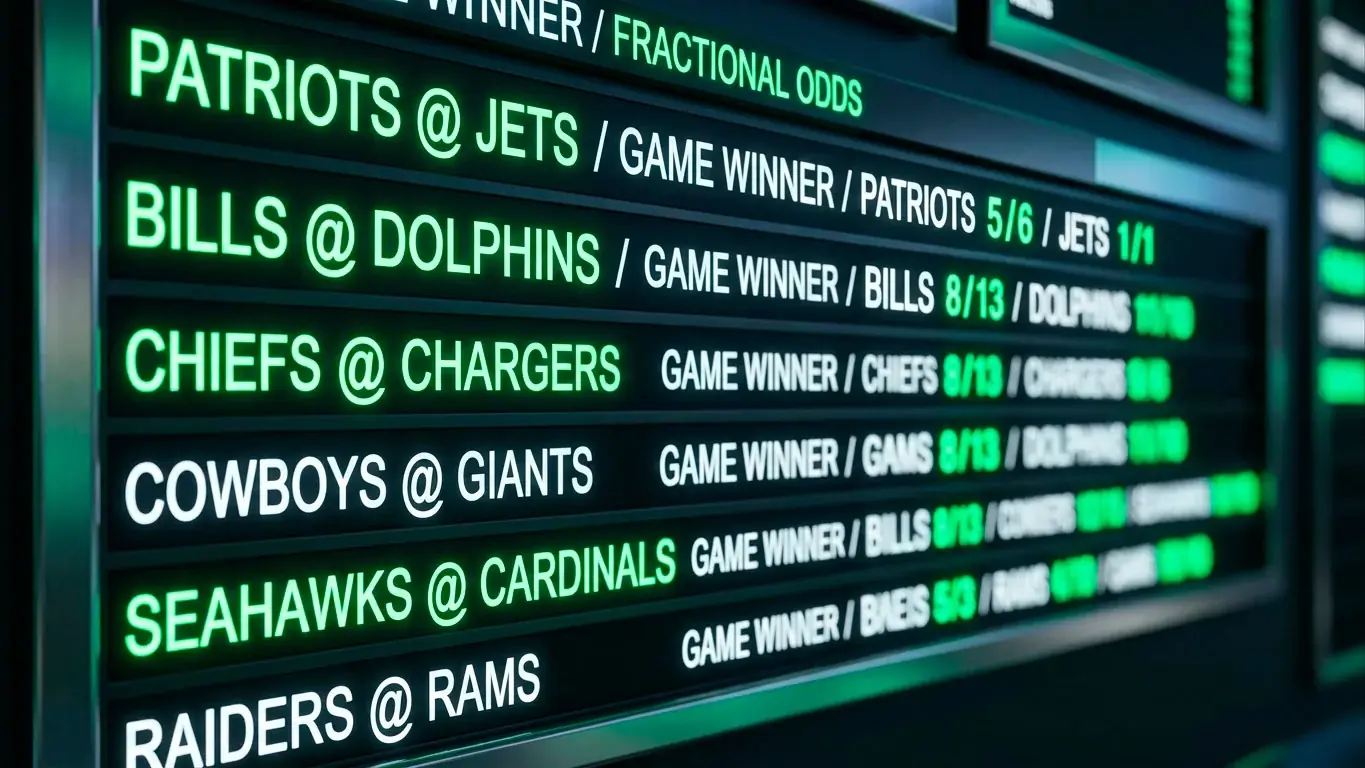
Open an NFL page at a UK sportsbook and you will see three primary markets for each game: the spread (often labelled “handicap”), the total (labelled “over/under”), and the moneyline (labelled “to win”). Some operators display all three side by side; others bury the spread and total behind a “more markets” tab. The default display varies, but the content is the same across platforms.
The spread will read something like “Buffalo Bills -3.5 (10/11) / Miami Dolphins +3.5 (10/11).” The moneyline might read “Buffalo Bills 4/9 / Miami Dolphins 7/4.” The total might read “Over 47.5 (5/6) / Under 47.5 (5/6).” These numbers tell you everything you need: who is favoured, by how much, and at what price.
UK sportsbooks often add NFL-specific markets that American books do not emphasise. “First touchdown scorer” is enormously popular in the UK market — a hangover from football betting culture where first goalscorer is one of the most wagered markets. The odds on first touchdown scorer in the NFL tend to carry a large overround because the outcome is highly variable and the bookmaker prices in significant margin. I bet this market only when I have a strong view based on red zone usage data, and even then rarely.
Enhanced-odds promotions on NFL games are common at UK sportsbooks, particularly during the Super Bowl and London Games. These offers — boosted prices on specific outcomes, acca insurance for NFL multiples, free bets tied to NFL action — are genuine value opportunities when the terms are favourable. The annual Super Bowl alone generated $1.76 billion in legal US wagers for Super Bowl LX, and UK bookmakers use the event to acquire new NFL bettors through promotional spending. Read the terms carefully, but do not ignore these offers reflexively. Some are structured in ways that give the bettor a real mathematical edge.
Live betting odds on NFL games are also widely available at UK operators, despite the time-zone challenge of Sunday afternoon kick-offs falling between 6pm and 9:25pm UK time. The late-afternoon window (6pm-7pm) is particularly active among UK bettors because it aligns with evening leisure time. Live odds shift rapidly based on in-game events — a turnover, a scoring drive, an injury to a key player — and the speed of adjustment varies by operator. Operators using automated models reprice faster than those relying on manual trading, which creates brief windows where the live odds at one book lag behind the game state. Exploiting those windows requires discipline and quick decision-making, but the edges can be meaningful.
The NFL betting market from the UK has never been more accessible or more liquid. The 290 million online bets processed monthly across all UK sports markets now include a growing proportion of American football wagers, and the trend accelerates each season as broadcast coverage expands and betting infrastructure matures. Understanding the odds — how they are built, what they imply, and how to compare them across operators — is not the only skill you need. But it is the one that makes every other skill useful.
What do the plus and minus signs mean in American NFL odds?
The minus sign indicates the favourite: -150 means you stake 150 to win 100. The plus sign indicates the underdog: +200 means you win 200 on a 100 stake. These are the American odds format used by US sportsbooks and media. UK bookmakers typically display the same odds in fractional or decimal format.
Why is the number 3 so important in NFL spread betting?
Three points is the value of a field goal, the most commonly scored play in the NFL. Roughly 15% of all NFL games are decided by exactly three points, making it the single most frequent margin of victory. Spreads that cross the number 3 — moving from -2.5 to -3.5 or vice versa — shift win probability by a disproportionately large amount compared to other half-point moves.
How do I calculate implied probability from betting odds?
For decimal odds, divide 1 by the odds and multiply by 100. Odds of 1.91 give you an implied probability of 52.4%. For fractional odds, divide the denominator by the sum of numerator and denominator, then multiply by 100. At 4/1, the implied probability is 1 / (4+1) = 20%. If the implied probabilities on both sides of a market sum to more than 100%, the excess is the bookmaker’s margin.
When is the best time to bet on NFL games from the UK?
Lines are typically most exploitable between Tuesday and Thursday, after opening numbers are posted but before the majority of public money arrives. By Sunday morning, the line has absorbed most available information and is closer to efficient. Betting early in the week gives you the best chance of capturing value before the market corrects.
Published by the Online Sports Betting nfl team.