NFL Betting Sites UK: Best Sportsbooks, Odds and Strategy for the 2026 Season
 Available in US
Table of Contents
- The 2026 NFL Betting Landscape in Five Takeaways
- NFL Betting in the UK: Market Size and Growth
- How to Bet on NFL Games From the UK
- NFL Bet Types at a Glance
- Reading NFL Odds: Fractional, Decimal, and American
- What Makes a Strong NFL Sportsbook for UK Bettors
- In-Play NFL Betting: Why It Dominates
- Super Bowl Betting From the UK
- NFL Betting Strategy: A Data-Driven Snapshot
- UK Gambling Regulation and NFL Betting
- Responsible Gambling When Betting on NFL
- Frequently Asked Questions
Nine years ago, I placed my first NFL bet from a flat in South London. It was a Thursday night game, the odds were in fractional format I barely understood, and I had no idea that the quarterback I was backing had been nursing a shoulder injury all week. I lost, obviously. But that evening started something I did not expect — a near-decade career spent dissecting NFL betting markets, tracking line movements across UK sportsbooks, and turning a casual punter’s hobby into a disciplined, data-driven practice.
The landscape has shifted enormously since then. The NFL now counts roughly 14.3 million fans in the United Kingdom — nearly one in five British adults. The global American football betting market has ballooned to $9.5 billion in 2026, growing at an 11.5% compound annual rate with no sign of slowing down. London games sell out in minutes. Sky Sports locks in multi-year Super Bowl broadcast deals. And every September, UK sportsbooks roll out NFL-specific markets, promotions, and bet builders that did not exist five years ago.
Yet most NFL betting guides aimed at UK punters read like carbon copies of each other: a list of bookmakers, a few welcome offers, and a paragraph about point spreads. That is not what this guide is. I have built it as the resource I wished I had when I started — a data-first analysis of the UK’s NFL betting ecosystem, from market mechanics and odds formats to regulatory shifts and strategic edges. No promotional noise. No fabricated rankings. Just the numbers, the context, and the practical knowledge you need to bet on the NFL from the UK with your eyes open.
The 2026 NFL Betting Landscape in Five Takeaways
- The UK’s NFL fan base has reached 14.3 million, and the global American football betting market now stands at $9.5 billion — creating deeper markets, tighter odds, and more competitive promotions at UKGC-licensed sportsbooks than ever before.
- Point spreads, moneylines, totals, props, parlays, and futures each carry different risk profiles and edge structures — choosing the right bet type for each game matters as much as choosing the right side.
- In-play betting accounts for over 62% of online sports betting revenue, and NFL’s stop-start rhythm makes it one of the best-suited sports for live wagering, particularly from a mobile device during late UK hours.
- Remote Gaming Duty doubled to 40% in April 2026, which will pressure sportsbook margins and may reduce promotional generosity — shop lines across multiple platforms to protect your edge.
- Responsible gambling is not a footnote: 1.4 million UK adults are classified as problem gamblers. Set deposit limits, use session reminders, and treat NFL betting as analytical entertainment, not income.
NFL Betting in the UK: Market Size and Growth
I remember a conversation with a fellow analyst in 2019 where he told me NFL betting in the UK was a “rounding error” compared to football and horse racing. He was not entirely wrong at the time. But he would be today. The numbers behind the UK’s NFL betting market have moved from curiosity to genuine commercial force, and understanding them changes how you approach every wager.
UK Adult Sports Bettors
10% of the adult population bets on sport online
Remote Betting GGY
£2.48 billion ($3.3 billion) annually as of early 2026
Monthly Online Bets
Approximately 290 million wagers placed on real events each month
NFL UK Fan Base
14.3 million fans — roughly one in five British adults
Global American Football Betting
$9.5 billion market in 2026, projected to reach $14.49 billion by 2030
Start with the broader picture. One in ten UK adults participates in online sports betting, and the remote sector generates £2.48 billion in gross gaming yield per year. Sports betting is the dominant gambling activity after the National Lottery, with 47% of British gamblers choosing it as their preferred format. Around 290 million online bets land on real events every month across UK platforms.
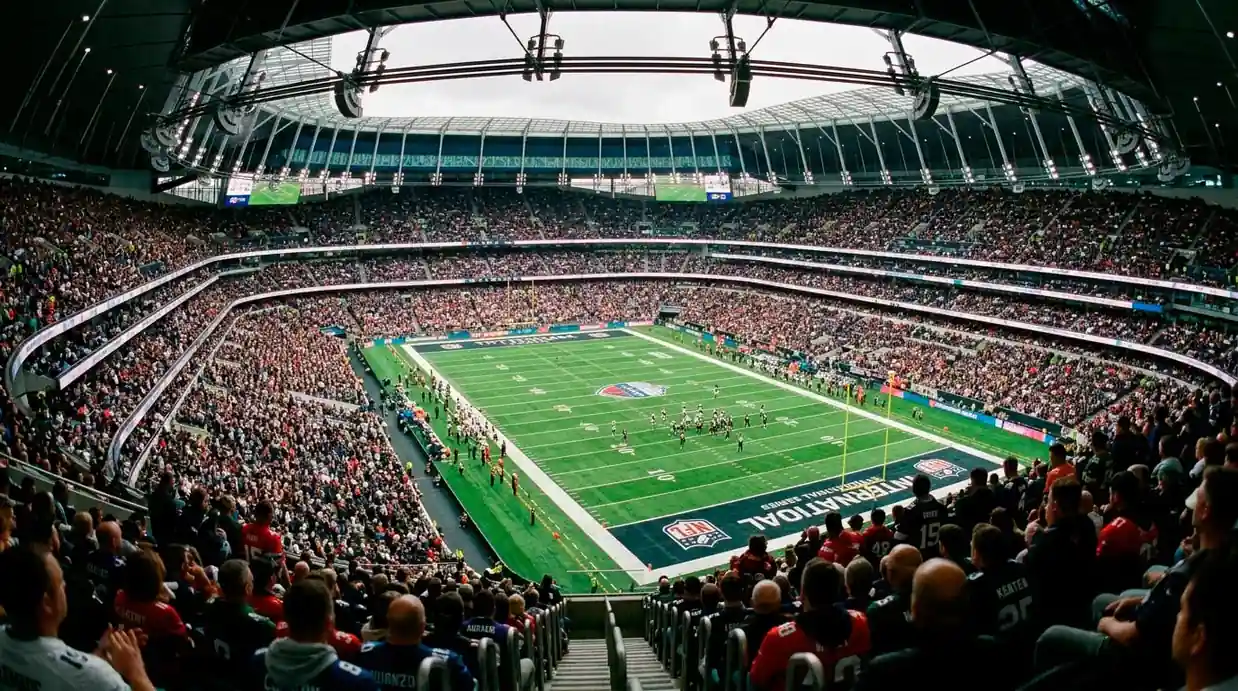
Now layer the NFL onto that foundation. The league’s UK following — the numbers in the panel above tell the story — generates around 1.2 million searches for NFL-related content every month, accounting for roughly 3% of global NFL web traffic. That is remarkable for a country with no domestic professional league. NFL Commissioner Roger Goodell has spoken openly about his vision for a permanent global presence, describing a future where teams play regular-season games across multiple international markets within the next decade. London, with three games hosted in 2025 and average attendance exceeding 80,000, sits at the centre of that expansion.
Why the UK Matters to the NFL
The international games staged in 2025 — a record seven regular-season fixtures played abroad — drew an average audience of 6.2 million viewers across television and digital platforms on NFL Network, a 32% year-on-year increase. Sky Sports has secured Super Bowl broadcast rights in the UK through 2028. The commercial infrastructure is no longer experimental; it is embedded.
For bettors, these numbers translate directly into market depth. More UK fans watching NFL means more demand for NFL markets at sportsbooks, which in turn means tighter odds, deeper prop selections, and more competitive promotions during the season. When I started betting NFL from the UK, most bookmakers offered three markets per game — spread, moneyline, total. Today, a midweek Thursday Night Football fixture will carry 150 or more individual betting options at the larger UK platforms. That expansion is a direct consequence of the audience growth charted above.
The global context reinforces the trajectory. The worldwide American football betting market grew to $9.5 billion in 2026, with projections of $14.49 billion by 2030. Europe accounts for approximately 44% of the global sports betting market, and the UK is its largest regulated online sector. The question is no longer whether NFL betting in the UK is significant — it is how quickly it compounds from here.
How to Bet on NFL Games From the UK
The first time a friend asked me to walk them through placing an NFL bet, I expected it to take five minutes. It took forty-five. Not because the process is complicated, but because there are details — account verification timelines, deposit method quirks, the gap between UK and US kickoff times — that nobody mentions until you hit them. Here is the streamlined version, built from the friction points I have seen trip up dozens of first-time NFL bettors.
The mechanical steps are straightforward: choose a UKGC-licensed sportsbook, register an account, verify your identity, deposit funds in GBP, navigate to the American football or NFL section, select your market, set your stake, and confirm. Most operators complete identity verification within hours, though some require a document upload that can add a day. I always recommend completing verification before the season starts — nothing is more frustrating than finding a line you like on opening weekend and being locked out pending a passport check.
Before Your First NFL Bet: The Quick Checklist
- Confirm the sportsbook holds a valid UKGC licence (check the Gambling Commission register)
- Complete identity verification and any enhanced due diligence requirements
- Set a deposit limit that reflects your bankroll — not your enthusiasm
- Familiarise yourself with fractional odds if you have not used them for NFL markets before
- Check the NFL schedule in UK time — Sunday 6pm kickoffs are 1am Monday in London
- Understand the specific settlement rules for overtime, postponements, and player non-participation
- Enable responsible gambling tools: reality checks, session time limits, loss limits
One detail that catches UK punters off guard is the time-zone mismatch. The NFL’s Sunday slate kicks off at 6pm Eastern Time in the US, which translates to 11pm in London during British Summer Time and midnight once the clocks shift. Monday Night Football finishes around 4am or 5am UK time. Thursday night games are marginally kinder — they start at 1:20am GMT. If you plan to bet live during these windows, your sportsbook’s mobile app becomes essential, because you will likely be placing wagers from bed, not a desktop.
Placing a Simple NFL Bet: Step by Step
1. Log in to your UKGC-licensed sportsbook and navigate to “American Football” or “NFL”
2. Select the game — for instance, a Week 4 matchup where Team A hosts Team B
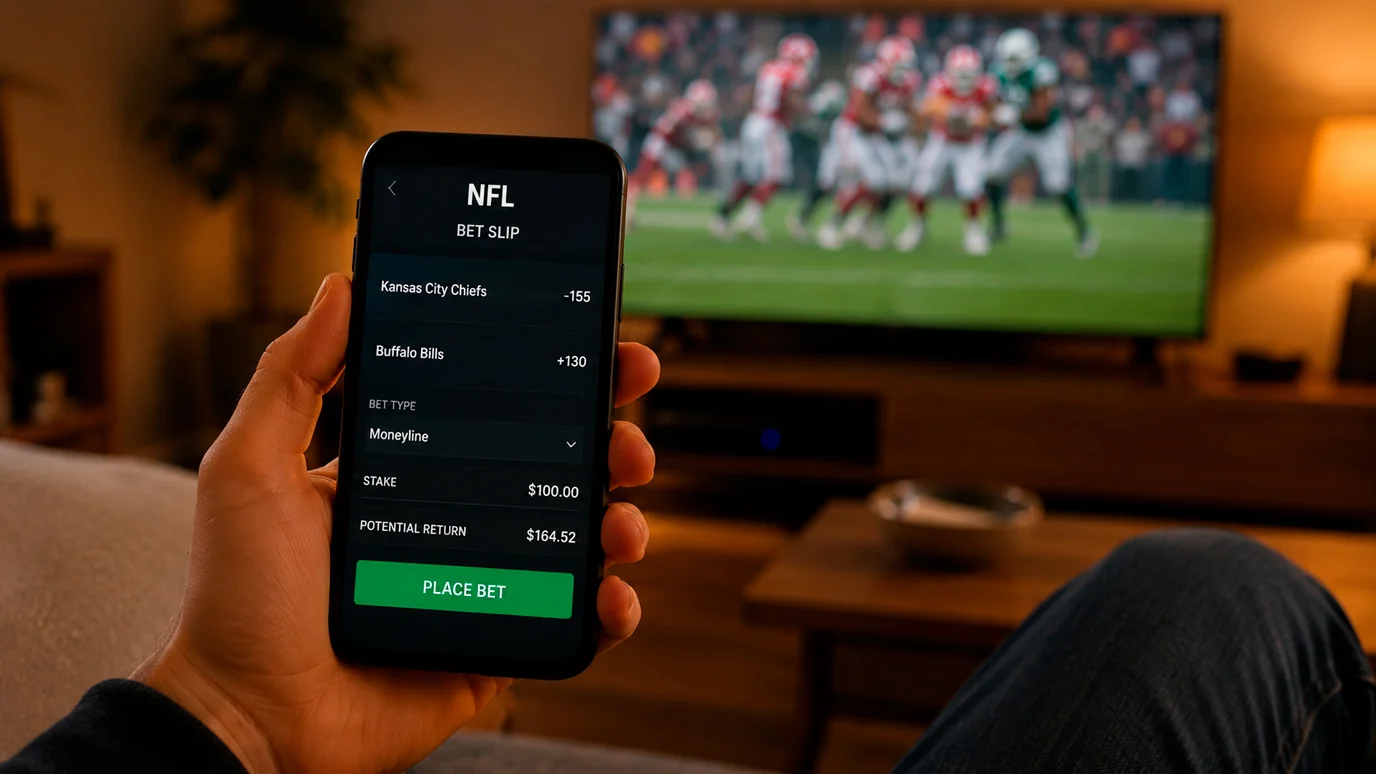
3. Choose your market. Suppose you want the point spread: Team A -3.5 at odds of 10/11
4. Enter your stake. At £20, the potential return at 10/11 is £20 x (10/11) = £18.18 profit, plus your £20 stake back, for a total return of £38.18
5. Review the bet slip — check the selection, odds, and stake are correct
6. Confirm the bet. The wager is now live and will settle after the game concludes, including overtime if applicable
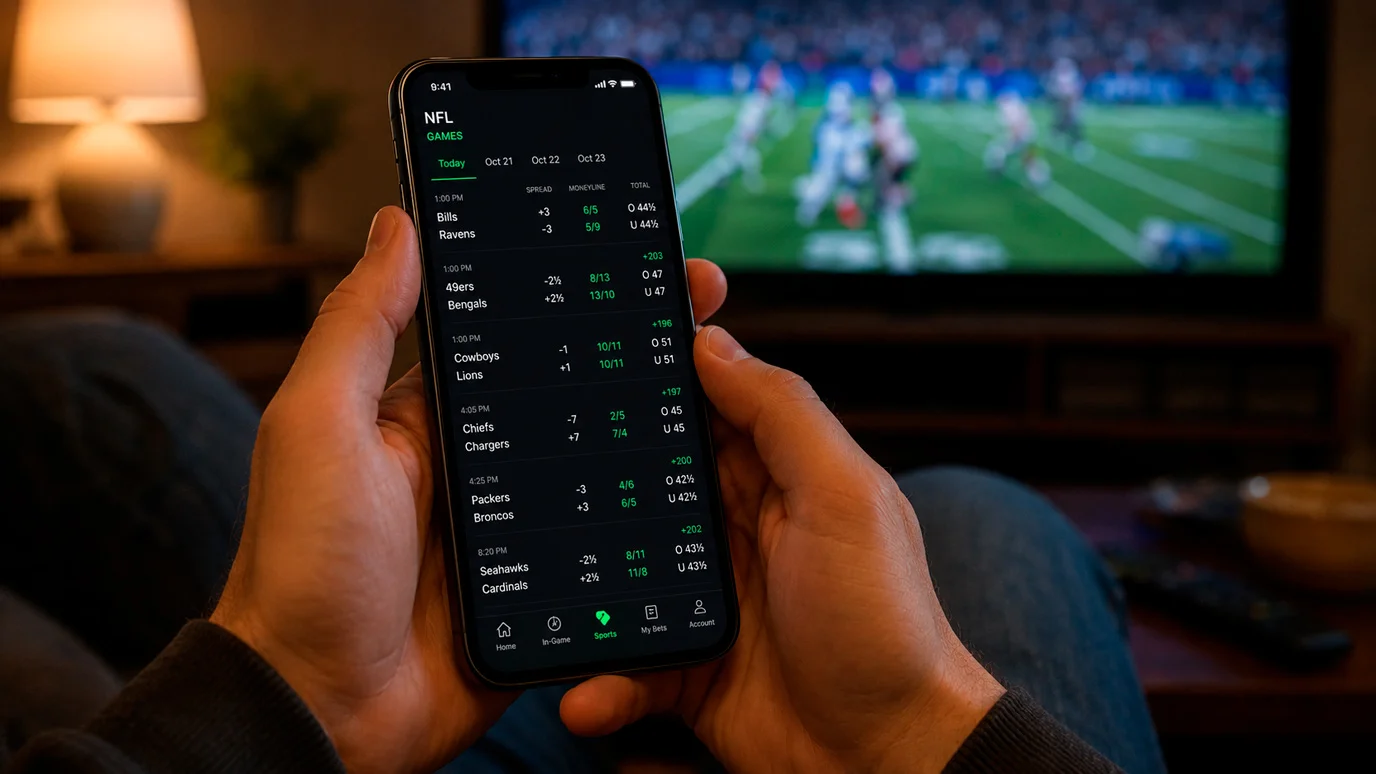
The demographic context is telling: 15% of men and 4% of women in the UK place sports bets, and NFL wagering skews toward the younger, digitally active segment of that population. Most NFL bettors I encounter are under 40, comfortable with mobile apps, and accustomed to late-night screen time — a profile that maps neatly onto the NFL’s UK broadcast schedule.
NFL Bet Types at a Glance
A colleague once described NFL betting markets as “a buffet where most people only ever try the bread rolls.” He was talking about the fact that a huge share of UK punters stick to straight match winners without ever exploring the full range of wagers available. I get it — spreads and totals look intimidating at first, and prop markets feel like a foreign language. But every bet type exists because it captures a different dimension of the game, and understanding the menu is the first step toward finding value others miss.
Here is a concise tour of the core NFL bet types you will encounter at UK sportsbooks. I cover each one in much greater detail in my full breakdown of NFL betting types, but this overview gives you the vocabulary and the logic behind each market.
Point Spread
The bookmaker sets a handicap — say, Team A -3.5 — and you bet on whether a team wins by more than that margin or keeps the game closer. This is the backbone of NFL betting in the US and increasingly popular in the UK. It levels the playing field between mismatched teams.
Moneyline
The simplest bet: pick the team that wins the game outright. No spread, no margin. Favourites carry shorter odds, underdogs carry longer ones. UK punters often gravitate here first because it mirrors how football match-result betting works.
Totals (Over/Under)
The sportsbook sets a combined score line — say, 47.5 points — and you wager on whether both teams together will score more or fewer. Totals strip away the question of who wins and focus entirely on how much scoring the game produces.
Spread Example
Game: Team A (-6.5) vs Team B (+6.5)
Odds: Team A -6.5 at 10/11 | Team B +6.5 at 10/11
Stake: £25 on Team A -6.5
Result: Team A wins 27-17 (margin of 10). Your bet wins — Team A covered the 6.5-point spread.
Return: £25 x (10/11) = £22.73 profit + £25 stake = £47.73 total
Beyond those three pillars, the NFL market expands into several more sophisticated territory. Parlays (called accumulators in UK terminology) combine multiple selections into one bet — all legs must win for the bet to pay, but the combined odds multiply significantly. Prop bets — short for propositions — let you wager on individual player performances or specific game events: passing yards, touchdown scorers, first team to score, total sacks. These have exploded in popularity alongside bet builder tools at UK sportsbooks.
Futures are long-range bets placed weeks or months before an outcome is decided: Super Bowl winner, conference champion, MVP, season win totals. The odds move constantly as the season unfolds, which creates opportunities for bettors who track roster changes and injury reports closely. And same game multis — a relatively recent addition — allow you to combine spread, total, and prop selections from a single fixture into one wager, with the sportsbook pricing the correlation between your picks.
Each bet type carries a different risk profile and a different relationship with the information available to you. Spreads reward detailed knowledge of team matchups. Props reward player-level research. Futures reward patience and conviction. The worst thing you can do is treat them all the same — and the best thing is to learn which ones match your analytical strengths.
Reading NFL Odds: Fractional, Decimal, and American
I have lost count of the number of times a UK bettor has messaged me saying, “I found a great line on an American site but I cannot figure out what -110 means.” Odds format confusion is the single most common stumbling block for British punters entering NFL markets, and it costs real money when you misread the implied probability behind a price. Three formats dominate NFL betting worldwide, and UK sportsbooks let you toggle between them — but you need to understand all three to evaluate lines properly.
| Feature | Fractional (UK Standard) | Decimal (Europe) | American (US Standard) |
|---|---|---|---|
| Displayed as | 10/11, 5/1, 2/7 | 1.91, 6.00, 1.29 | -110, +500, -350 |
| Shows | Profit relative to stake | Total return per unit staked | Amount to risk/win based on $100 |
| Most familiar to | UK punters (horse racing, football) | European bettors, exchanges | US sportsbooks, NFL media |
| Quick mental maths | Divide numerator by denominator for profit per £1 | Subtract 1 for profit per £1 | Negative: divide number by (number + 100); Positive: divide 100 by (number + 100) |
| Even money equivalent | 1/1 (evens) | 2.00 | +100 / -100 |
Fractional odds are what most UK bettors grew up with. At 10/11, you stake £11 to win £10 profit, implying a 52.38% probability. At 5/1, you win £5 per £1 staked, implying roughly 16.67%. Decimal odds, dominant on exchanges and across continental Europe, represent total return per unit including your stake: 1.91 means a £10 bet returns £19.10. Convert fractional to decimal by dividing the fraction and adding 1.
American odds trip up UK bettors most often because the format splits into positive and negative numbers. A negative figure like -110 tells you how much you must stake to win $100 (in this case, $110). A positive figure like +250 tells you how much you win on a $100 stake ($250). The key insight: -110 and 10/11 are the same price, just expressed differently. When you see NFL lines quoted on American broadcasts or social media, mentally convert them before comparing against your UK sportsbook’s fractional display.
Converting American to Fractional: A Quick Example
1. Take the American odds: -150
2. This means you stake 150 to win 100
3. Express as a fraction: 100/150, which simplifies to 2/3
4. In fractional odds: 2/3 (stake £3 to win £2 profit)
5. Implied probability: 150 / (150 + 100) = 60%
For positive odds like +200: the fraction is 200/100, which simplifies to 2/1. Implied probability: 100 / (200 + 100) = 33.3%
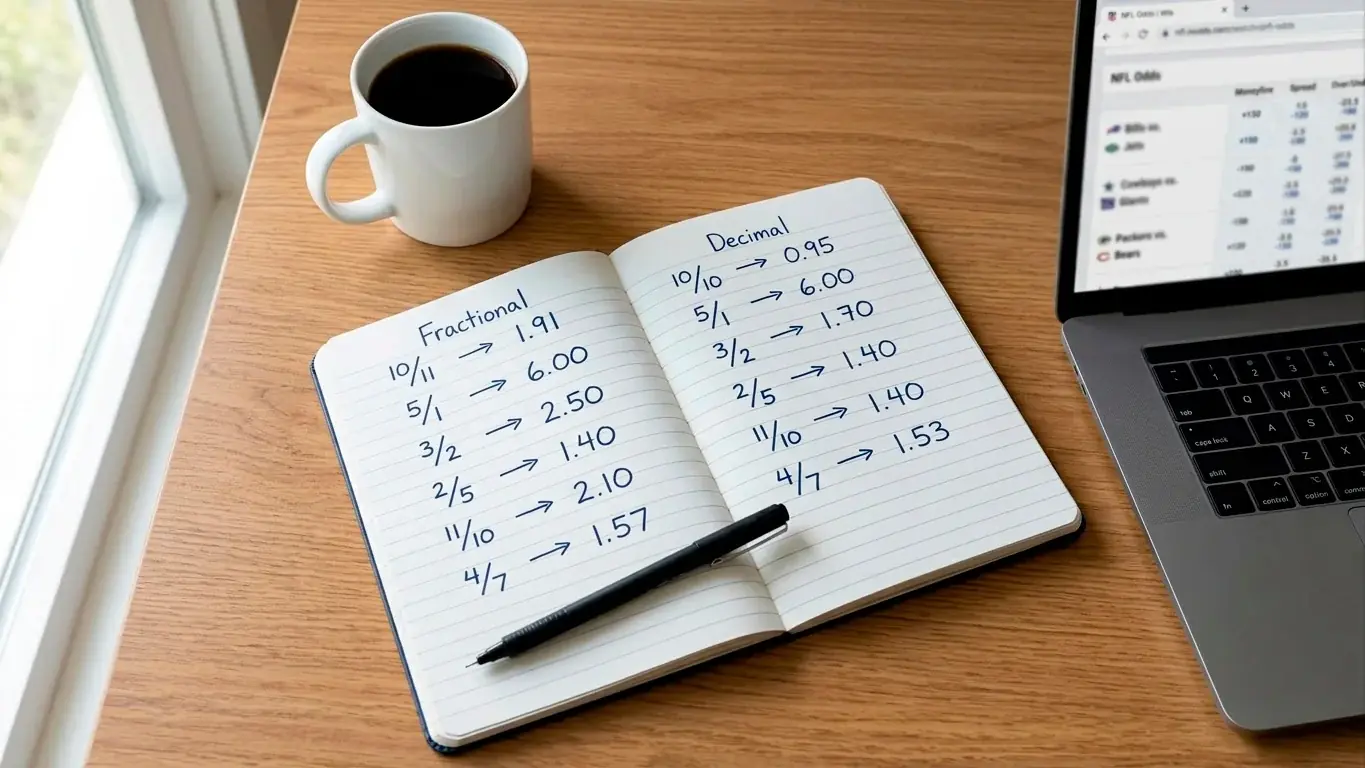
Why does this matter beyond academic interest? Because value lives in the gap between what you believe the true probability is and what the odds imply. If you cannot calculate implied probability fluently in all three formats, you will miss mispriced lines or, worse, back bets where the bookmaker’s margin has already eaten the edge. Every serious NFL bettor I know can glance at -130, 1.77, or 4/6 and instantly know they are looking at the same 56.5% implied probability. That fluency is not optional — it is foundational.
What Makes a Strong NFL Sportsbook for UK Bettors
Here is something I learned the hard way during the 2020 season: the sportsbook that gives you the best welcome offer is not necessarily the one that gives you the best NFL betting experience twelve weeks later. I signed up with a platform that had a generous free-bet promotion but carried only forty NFL markets per game and took thirty seconds to load its live betting interface. By Week 6, I had moved my bankroll elsewhere. The criteria that matter for sustained NFL betting from the UK are specific, measurable, and often overlooked in favour of flashy sign-up deals.
The first non-negotiable is a valid UK Gambling Commission licence. This is not a box-ticking exercise. A UKGC licence means the operator is subject to regular audits, must ring-fence customer funds, must participate in the GAMSTOP self-exclusion scheme, and must comply with advertising standards that protect vulnerable consumers. Given that the remote online betting sector’s gross gaming yield grew 8% year-on-year to £1.42 billion in the second quarter of 2025, competition among licensed operators is fierce — and that competition benefits you as a bettor through tighter margins and deeper markets.
Sector Growth
Remote GGY up 8% YoY to £1.42 billion (Q2 2025)
Top Operator Revenue
Flutter Entertainment: $15.91 billion in 2025 (+17% YoY)
Market Contrast
Entain posted a £681 million net loss in 2025, partly from £488 million in impairments
Those numbers illustrate a widening gap between the strongest and weakest major operators. For bettors, this means your NFL experience varies dramatically by platform. A well-capitalised operator invests in deeper market coverage, faster live-betting technology, and more competitive pricing. A struggling one cuts corners on exactly those features.
Beyond licensing and financial stability, three criteria separate strong NFL sportsbooks from mediocre ones. Market depth is the clearest differentiator — a good platform offers 120 or more markets per regular-season game, covering spreads, props, quarter lines, and bet builder compatibility. If a platform carries fewer than 80 markets for a standard Sunday fixture, it is not treating NFL seriously. Live betting speed matters disproportionately because NFL’s stop-start rhythm creates dozens of pricing windows per game; I test this by watching how quickly a platform re-prices after a touchdown. And odds competitiveness compounds over a season — a sportsbook with a 4.5% margin on spreads costs you meaningfully more than one at 3.5% across hundreds of bets.
Sports marketing consultant Jamie Reynolds has observed that British fans tend to be less tribally attached to specific NFL teams than their American counterparts. That behavioural difference matters for sportsbook selection: UK NFL bettors are more likely to follow the best lines and the best markets across multiple platforms rather than staying loyal to one. Treat sportsbook selection as a portfolio decision, not a marriage.
Do
- Verify the sportsbook’s UKGC licence before depositing
- Compare NFL odds across at least three platforms before placing a bet
- Test the live betting speed during a real game before committing your bankroll
- Check how many player prop markets the platform offers per NFL game
- Read the settlement rules for overtime and postponements in the terms
Don’t
- Choose a sportsbook based solely on the welcome offer
- Assume all UKGC-licensed operators offer the same NFL market depth
- Ignore mobile app performance — most NFL betting happens on phones during UK night hours
- Overlook the margin on spreads and totals in favour of flashy acca boosts
- Stick with a single platform when better odds are available elsewhere
In-Play NFL Betting: Why It Dominates
Last December, I was watching a late Sunday game from my phone in a taxi heading home from a dinner. The away team had just fumbled at their own 15-yard line, and I managed to grab a live spread adjustment before the sportsbook re-priced. The entire sequence — fumble, notification, bet slip, confirmation — took about twelve seconds. That kind of moment is why in-play betting has become the dominant revenue driver across all online sports wagering, and NFL’s structure makes it uniquely suited to the format.
In-play betting accounted for 62.35% of all online sports betting revenue globally in 2025 — meaning nearly two out of every three pounds wagered on sport online are placed after the opening whistle.
The NFL is built for live betting in a way that few other sports can match. American football’s natural rhythm — play, huddle, play, timeout, commercial break, two-minute warning — creates dozens of distinct pricing windows within every game. Each stoppage gives sportsbooks time to recalculate odds and gives you time to assess what just happened. Compare that to football, where play is continuous and live markets often lock during fast-moving phases. NFL in-play betting is more deliberate, more analytical, and more accessible to punters who want to think before they click.
What Opens Up In-Play
Once an NFL game kicks off, UK sportsbooks typically expand the available markets beyond the pre-game menu. Live spreads adjust after every scoring play. Drive-result markets let you bet on whether the current possession ends in a touchdown, field goal, punt, or turnover. Next-score markets, live player props, and quarter-specific lines all become active. The deeper the platform’s in-play offering, the more granular your betting can be — and the more edges surface for those paying attention.
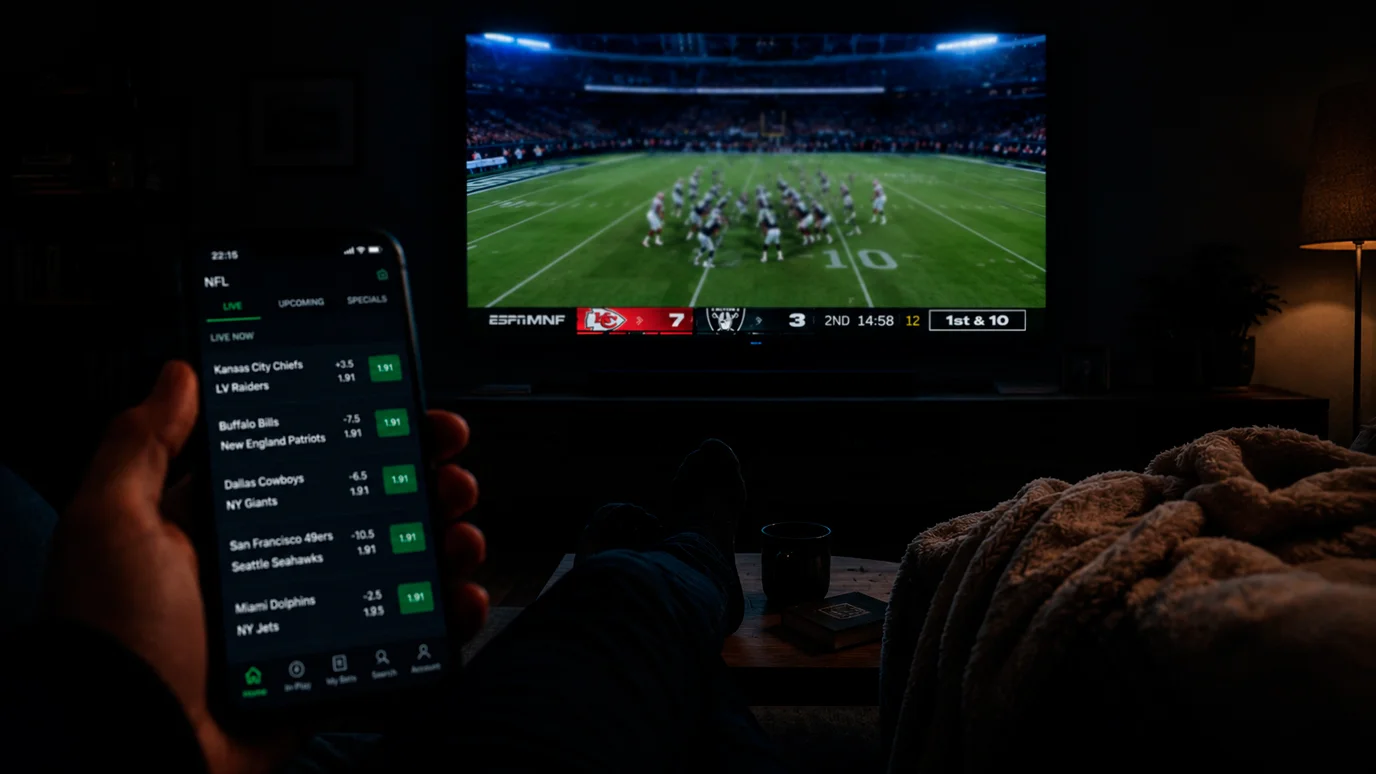
For UK bettors specifically, the time-zone factor amplifies the importance of mobile in-play tools. Most NFL action happens between 6pm and midnight Eastern Time, which translates to 11pm through 5am in the UK during the regular season. You are not sitting at a desktop for those hours. You are on your phone, likely watching a stream on one device and placing bets on another. The quality of a sportsbook’s NFL live betting interface — speed, clarity, market range — becomes the decisive factor in whether you can capitalise on in-game opportunities or watch them evaporate while a sluggish app loads.
One pattern I have tracked over several seasons: the sharpest live-betting edges in NFL tend to appear in the first five minutes after halftime and immediately following turnovers. Both moments create temporary mispricings because the market is reacting emotionally to a dramatic event. If you can stay analytical while the crowd (and the algorithm) overreact, in-play NFL betting from the UK is arguably the highest-value window in the entire sport.
Super Bowl Betting From the UK
There is one Sunday every February when I do not sleep. Not because of insomnia — because the Super Bowl is the single biggest betting event on the annual calendar, and the UK’s relationship with it has evolved from a novelty viewing party into a serious wagering occasion. The numbers behind the most recent edition illustrate the scale better than any description I could write.
Super Bowl LX Legal Handle
$1.76 billion — an all-time record
Super Bowl LIX Viewership
127.7 million viewers — the most-watched Super Bowl ever
UK Broadcast Deal
Sky Sports holds Super Bowl rights through 2028
Super Bowl LX generated a record $1.76 billion in legal wagers — a figure that would have been unimaginable a decade ago and one that reflects the mainstreaming of NFL betting across regulated markets. The preceding year’s Super Bowl LIX drew 127.7 million viewers, the largest American television audience in history, and analysts at Macquarie Equity Research described the event as a major long-term positive for sportsbooks in terms of customer acquisition. Their reasoning was straightforward: record viewership driven partly by wider access to legal online sports betting creates a self-reinforcing cycle where more viewers become more bettors, who in turn become more engaged viewers.
From a UK perspective, Super Bowl Sunday — technically Super Bowl Monday, given the time difference — has its own rhythm. The game typically kicks off around 11:30pm GMT, which means the first half unfolds just past midnight and the final whistle lands somewhere around 3:30am. That late-night window compresses decision-making and amplifies the importance of preparation. I do most of my Super Bowl betting work in the days and weeks before the game, placing futures, prop selections, and pre-game spreads well in advance. Live wagering during the event itself is a bonus, not the core strategy.
Super Bowl Market Depth
The Super Bowl is the one NFL game where market depth at UK sportsbooks approaches what US platforms offer year-round. Expect 300+ individual markets at major operators: game lines, first-half and quarter spreads, player props across every statistical category, novelty props (coin toss result, length of the national anthem), and same-game multi options that let you combine props and outcomes into a single wager. The dedicated Super Bowl betting guide walks through each category in detail.
The strategic consideration unique to the Super Bowl is market maturity. Because lines open weeks before the game and attract global attention from the moment they are posted, Super Bowl odds are among the sharpest and most efficient in all of sports betting. Finding an edge in the main game line is genuinely difficult. The value, in my experience, tends to live in the prop markets — particularly player props that hinge on game-script projections the broader market has not fully priced. A defensive-heavy game plan that suppresses passing volume, for instance, can create under-valued rushing props that the headline odds do not capture.
NFL Betting Strategy: A Data-Driven Snapshot
Most NFL betting “tips” you will find online amount to someone’s gut feeling dressed up in confident language. I have been guilty of it myself in my early years — backing a team because they “felt due” for a win or because a quarterback “looked sharp” in a pre-game interview. Nine years of tracking my own results taught me that profitable NFL wagering is built on repeatable analytical frameworks, not instinct. The global sports betting market surpassed $125 billion in 2026, and the share captured by disciplined, data-driven bettors grows every season as the tools become more accessible.
What follows is not a comprehensive strategy manual — that is what the full NFL betting strategy guide is for. This is a snapshot of the analytical pillars that have consistently produced edges in my experience, designed to show you where to focus your research rather than hand you conclusions.
Rest and Schedule Edges
NFL teams on short rest (Thursday games after a Sunday fixture) perform measurably worse against the spread than teams coming off a bye week. The gap is not enormous — typically 1 to 2 points of ATS value — but it is one of the most persistent and well-documented situational factors in professional American football. Bye weeks also matter for injury recovery, scheme adjustments, and coaching preparation time.
Weather and Environment
Wind speeds above 15 mph suppress passing efficiency and push totals lower. Snow and extreme cold have less predictable effects on scoring than most bettors assume, but they do increase turnover rates. Dome teams travelling to outdoor cold-weather venues in December and January face a quantifiable disadvantage that the market sometimes underprices.
Line Movement and Sharp Money
When an NFL spread moves 1.5 points or more between opening and closing, it is almost always driven by professional bettors (sharps) rather than public money. Tracking the direction and timing of these moves — especially in the final 90 minutes before kickoff — gives you a proxy for where informed money is landing.
Beyond these structural edges, the NFL rewards attention to situational context in ways that other sports do not. Lookahead spots — where a team faces a weak opponent the week before a marquee divisional rivalry — create motivational gaps that show up in ATS performance. Letdown spots after emotional wins follow a similar pattern. Revenge games, where a team faces the opponent that eliminated them from the previous year’s playoffs, carry a measurable intensity boost that occasionally moves the needle on spreads.
None of these factors works in isolation. The edge comes from layering them — finding a game where the schedule, the weather, and the situational context all point in the same direction while the market has not fully adjusted. That convergence is rare, which is why patience and selectivity are strategic advantages in NFL betting. Betting every game is the fastest way to erode a bankroll. Betting only when your analysis identifies genuine value is the slowest, most boring, and most effective approach I have found.
Strategy tells you where to look for value — but the regulatory framework determines the rules of the game itself. The UK’s gambling landscape is shifting faster than most bettors realise.
UK Gambling Regulation and NFL Betting
In April 2026, a tax rate doubled overnight. That is not an exaggeration. Remote Gaming Duty — the levy that online gambling operators pay on their UK revenue — jumped from 21% to 40% on the first of the month. It was one of the most aggressive regulatory moves in UK gambling history, and if you are betting on NFL from the UK, its consequences will reach your account in ways that are already becoming visible.
Key Regulatory Changes: 2026-2027
Remote Gaming Duty rose from 21% to 40% effective 1 April 2026. Remote Betting Duty is scheduled to increase to 25% from 1 April 2027, with UK horse racing remaining at the current 15% rate. These reforms are projected to generate £810 million for the Treasury in 2026/27, scaling to £1.16 billion annually by 2030/31.
The practical impact on NFL bettors is indirect but real. Operators absorb the tax increase in three ways: wider margins on odds, reduced promotional spending, and fewer loss-leading welcome offers. You will not see “Remote Gaming Duty surcharge” on your bet slip, but the mathematical reality is that a sportsbook paying 40% tax on gaming revenue has less room to offer competitive pricing than one paying 21%. I have already noticed marginally wider spreads on NFL markets at some platforms compared to the previous season, and that trend will likely continue as the new rate beds in.
What UKGC Licensing Means for You
Every sportsbook legally offering NFL betting in the UK must hold a licence from the UK Gambling Commission. This guarantees several protections: customer funds must be ring-fenced or held in segregated accounts, the operator must participate in the GAMSTOP national self-exclusion register, all advertising must meet ASA and UKGC standards, dispute resolution must be available through an approved ADR provider, and the platform must implement affordability checks and responsible gambling tools. These are not voluntary guidelines — they are conditions of the licence, and breaching them risks suspension or revocation.
Legal analysts at Clifford Chance described the 2025 regulatory wave as a decisive shift in how the UK approaches gambling oversight, noting the introduction of a statutory levy, targeted stake limits, and enhanced consumer protections that position the UK as a leader in responsible regulation. For bettors, the practical takeaway is that the UK remains one of the safest jurisdictions in the world to bet on NFL — but the cost of that safety is increasingly borne by operators, which filters through to pricing and promotions.
The Remote Betting Duty increase to 25% in April 2027 adds another layer. This levy applies specifically to bets on real events — which includes every NFL wager you place. Again, the operator absorbs the duty rather than adding it to your stake, but the economic pressure on margins is cumulative. Smaller operators may reduce their NFL market coverage or slow down investment in live-betting technology. Larger operators will spread the cost across their global businesses. Either way, the competitive dynamics of the UK sportsbook market are shifting, and NFL bettors who understand the regulatory context will make sharper decisions about where and how they allocate their activity.
The broader direction of travel matters too. The introduction of online slot stake limits — £5 for over-25s, £2 for 18-to-24-year-olds — signals a regulatory philosophy that prioritises harm reduction over market growth. NFL betting is not directly affected by slot limits, but expect more affordability checks, more friction in the deposit process, and more transparency requirements from operators in the coming years.
Responsible Gambling When Betting on NFL
I almost did not include this section. Not because it is unimportant — the opposite — but because most gambling guides treat responsible gambling as a legal disclaimer bolted onto the end, a paragraph of boilerplate that nobody reads. I want to do something different here, because the data on gambling harm in the UK is sobering enough to warrant genuine engagement rather than a checkbox.
The Numbers Behind Gambling Harm
Approximately 2.7% of UK adults — around 1.4 million people — score 8 or higher on the Problem Gambling Severity Index, placing them in the “problem gambler” category. Public Health England estimates that roughly 400 gambling-related suicides occur annually in England alone. These are not abstract statistics. They represent real consequences of an activity that most participants engage in responsibly but that a significant minority cannot control.
Andrew Rhodes, Chief Executive of the UK Gambling Commission, has been direct about what the data reveals: the Commission’s findings are deepening the understanding of gambling’s consequences and exposing risk profiles among the most frequent bettors, and he has strongly encouraged operators to use this evidence when assessing the risks within their own customer bases. That is regulator-speak for “the problem is bigger than you think, and operators need to act on it.”
NFL betting carries specific risk factors that general responsible-gambling advice does not always address. The season runs eighteen weeks of regular play followed by playoffs and the Super Bowl — a sustained period of near-constant betting opportunity from September through February, with wagering decisions available at least three days every week. The late-night UK schedule adds fatigue to the equation. Making impulsive bets at 2am after a frustrating loss is a pattern I have seen in dozens of people, including a version of myself in my early years.
Keith Whyte, Executive Director of the National Council on Problem Gambling, has noted a worsening risk profile among sports bettors: more respondents report believing gambling is a good way to make money, relying on it for daily expenses, and lying about their activity to family members. The NFL itself has committed $6.2 million to a three-year responsible betting programme in partnership with the NCPG — an acknowledgment that growth creates obligations alongside opportunities.
Do
- Set a deposit limit before the season starts and treat it as inviolable
- Use session time reminders — most UKGC-licensed apps offer them
- Track your betting results honestly, including losses, across the full season
- Take a complete break from betting during any week where frustration or chasing behaviour appears
- Treat NFL betting as entertainment with an analytical component, not as income
Don’t
- Increase stakes to recover previous losses — this is the definition of chasing
- Bet on NFL games you have not researched simply because the market is open
- Dismiss responsible gambling tools as “not for me” — they exist for everyone
- Bet under the influence of alcohol or extreme fatigue, particularly during late-night UK NFL windows
- Ignore the signs: spending beyond your limit, lying about losses, or betting to escape stress

If you or someone you know is experiencing harm from gambling, GamCare provides free support and counselling through its helpline and online chat. GAMSTOP allows UK residents to self-exclude from all UKGC-licensed online gambling platforms for a minimum of six months. These are not last-resort options — they are tools designed to be used proactively, and accessing them is completely confidential. The strongest bet you will ever make is the one you choose not to place when the conditions are wrong.
Frequently Asked Questions
Is it legal to bet on NFL games in the UK?
Betting on NFL games from the UK is entirely legal when you use a sportsbook licensed by the UK Gambling Commission. Any operator offering NFL markets to UK residents must hold a valid remote operating licence, which you can verify on the Commission’s public register. There are no restrictions on which games, markets, or bet types you can access at licensed platforms.
How do NFL odds work for UK bettors — fractional vs American?
UK sportsbooks display NFL odds in fractional format by default. At 10/11, you stake £11 to win £10 profit. American odds use a positive/negative system: -110 means you risk 110 units to win 100, while +200 means you win 200 on a 100-unit stake. Both formats express the same probabilities differently. Most UK platforms let you toggle between fractional, decimal, and American in your account settings.
What types of bets can I place on NFL games?
UK sportsbooks offer a wide range of NFL bet types. The three core markets are point spread (handicap betting on the margin of victory), moneyline (picking the outright winner), and totals (betting on whether the combined score lands over or under a set number). Beyond those, you can place parlays or accumulators combining multiple selections, proposition bets on individual player performances, futures on season-long outcomes like the Super Bowl winner or MVP, and same-game multis that combine props and game lines from a single fixture. Major UK platforms now carry 120 or more markets per regular-season NFL game.
When does the NFL season start and end?
The NFL regular season typically begins in the first week of September and runs for eighteen weeks through early January. The playoffs follow immediately, spanning three rounds — Wild Card, Divisional, and Conference Championship — across January. The Super Bowl takes place in early to mid-February. Pre-season games run through August and carry limited betting markets. Futures markets — such as Super Bowl winner, division winners, and season win totals — open as early as February after the previous Super Bowl and remain active throughout the offseason, making NFL a near year-round betting proposition.
Which UK betting sites offer the best NFL odds?
No single UK platform consistently offers the best NFL price on every market. The most effective approach is to maintain accounts at three or four UKGC-licensed sportsbooks and compare lines before placing significant wagers. Pay particular attention to margins on point spreads and totals, where small pricing differences compound over a full season.
Can I live stream NFL games through UK bookmakers?
Some UKGC-licensed sportsbooks offer live streaming of selected NFL games, though coverage varies by operator. Sky Sports holds the primary UK broadcast rights, including the Super Bowl, through 2028. NFL Game Pass provides comprehensive access to every game. If streaming matters to your in-play NFL betting workflow on mobile, check the operator’s streaming schedule before the season starts.
How does responsible gambling apply to NFL betting?
All UKGC-licensed sportsbooks must provide responsible gambling tools: deposit limits, loss limits, session time reminders, and cooling-off periods. GAMSTOP self-exclusion covers all licensed online platforms simultaneously. The NFL’s eighteen-week season combined with late-night UK kick-off times creates sustained betting exposure that warrants proactive use of these tools. GamCare and the National Gambling Helpline offer free, confidential support.
Published by the Online Sports Betting nfl team.