NFL Live Betting UK: In-Play Markets, Odds Moves and Tactics
 Available in US
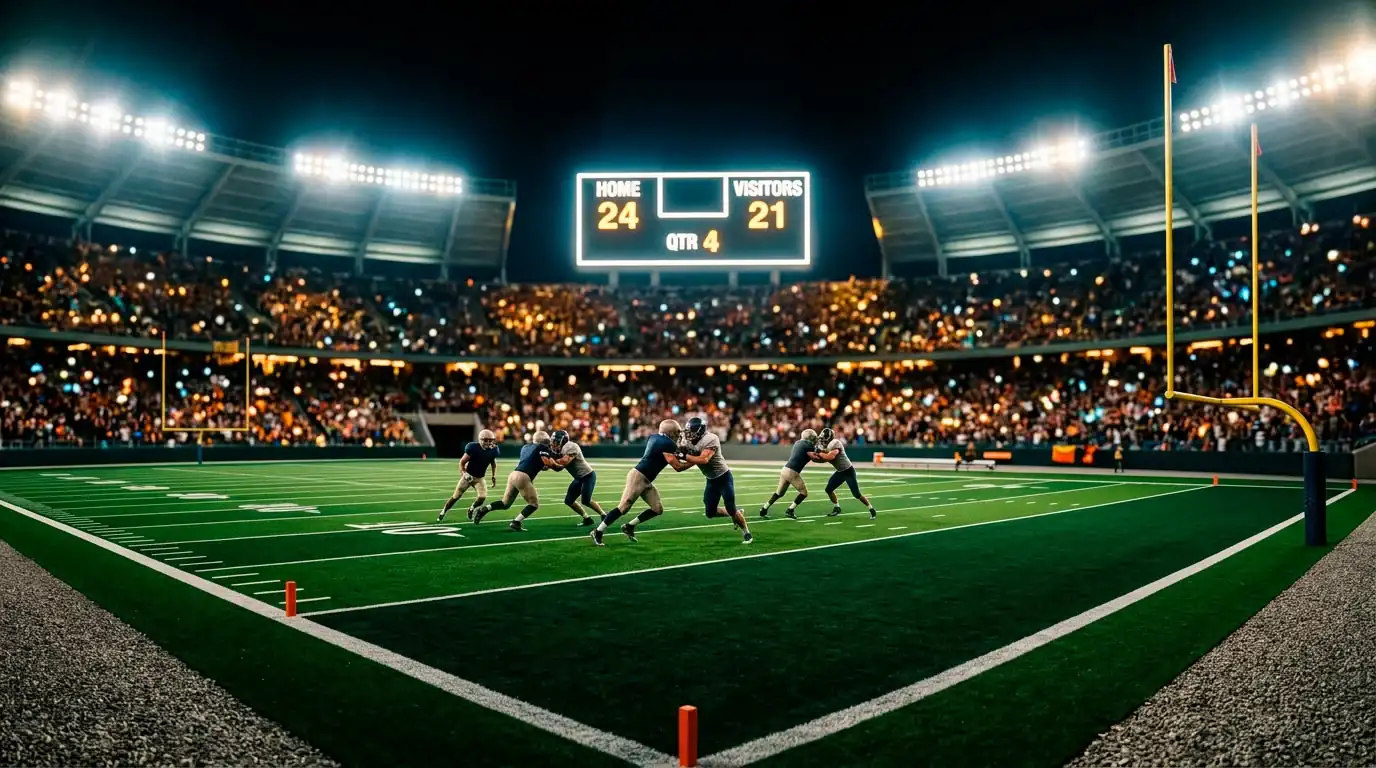
At 1:47 a.m. on a Monday morning in November, I watched the 49ers score a go-ahead touchdown on my phone and immediately placed a live bet on the opposing team’s next drive — a specific response to a defensive adjustment I had spotted over the previous three possessions. That bet won. The entire sequence, from kickoff return to settlement, took four minutes. That is NFL live betting in the UK distilled to its essence: fast decisions, deep markets, and the constant tension of acting on information that is already shifting by the time you tap “confirm.”
In-play wagering now generates 62.35% of all online sports betting revenue globally, and the NFL — with its stop-start rhythm, frequent stoppages, and data-dense broadcast — is arguably the sport best suited to live betting. Every play produces measurable information. Every timeout creates a window to reassess. Every quarter break gives you a structured pause to evaluate whether your pre-game thesis still holds.
For UK bettors, live NFL betting comes with a unique logistical challenge: time zones. Most regular-season action starts at 6 p.m. on a Sunday and the late games do not finish until well past midnight. Monday and Thursday night games kick off at 1:15 a.m. and 1:20 a.m. respectively. This guide covers not just how in-play NFL betting works, but how to do it effectively from a UK time zone — including when the sharpest opportunities tend to appear and why the late-night window is not the disadvantage it might seem.
How NFL In-Play Betting Works
The first thing to understand about NFL in-play betting is that it operates on a fundamentally different rhythm than live betting on football or tennis. In the Premier League, the ball is in play for roughly 55-60 minutes out of 90, and odds adjust fluidly. In the NFL, the ball is in play for about 11 minutes out of a three-hour broadcast. The rest is huddles, timeouts, commercial breaks, replay reviews, and the two-minute warning. This stop-start structure means live NFL odds do not flow — they jump.
Between plays, the sportsbook’s trading algorithm ingests the result of the previous snap (gain of seven yards, incomplete pass, sack for a loss of four) and recalculates the probability model. New odds are posted. You have a window — sometimes as short as fifteen seconds, sometimes as long as a full timeout — to evaluate and act before the next play begins and the market suspends again. During extended stoppages like injury timeouts or replay challenges, the window stretches to several minutes, and these are often the moments where the most considered in-play bets are placed.
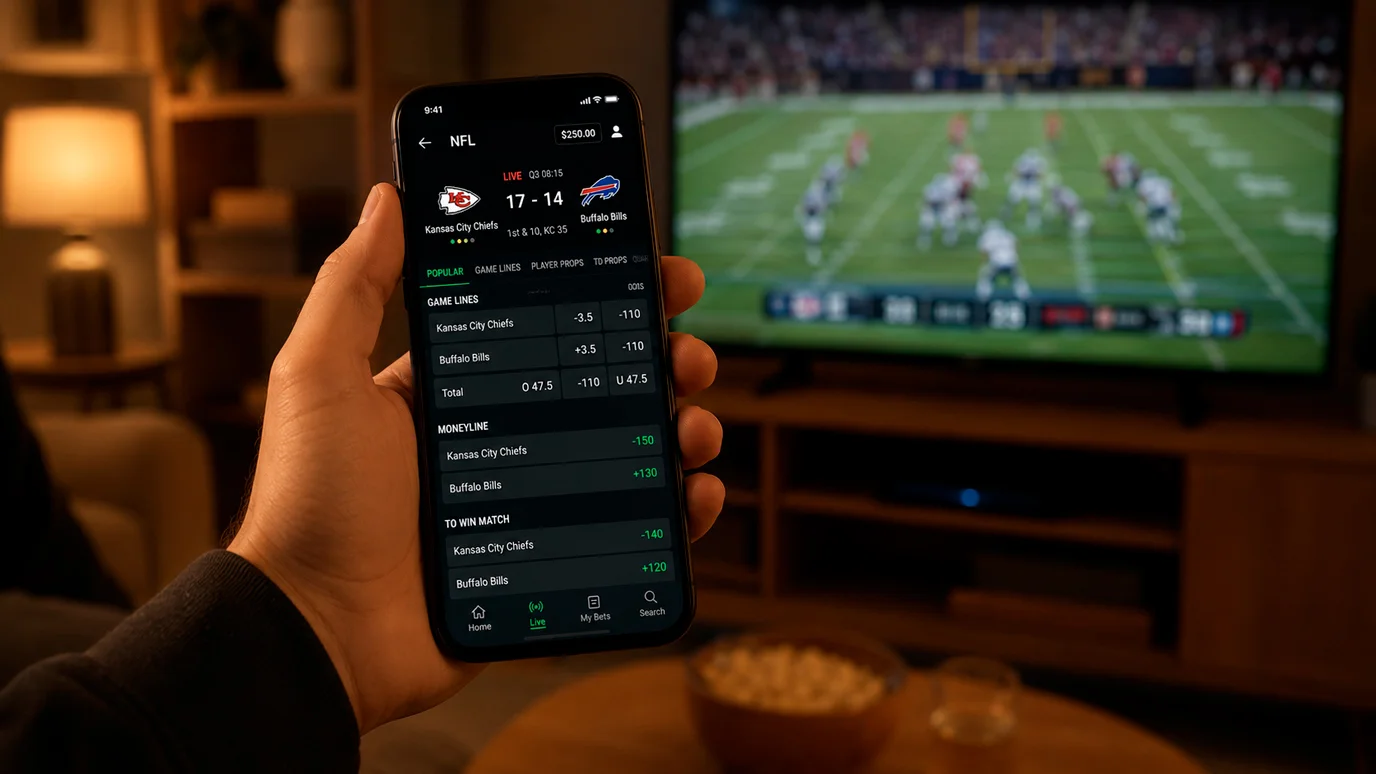
The practical mechanics at a UK sportsbook are straightforward. You navigate to the live betting section, select the NFL game in progress, and see a menu of available markets with odds that refresh in near-real-time. Some platforms show a visual game tracker (down and distance, field position, time remaining); others rely on text updates. A few offer live streaming of the game directly within the app, which eliminates the need for a separate broadcast — though the stream typically runs 5-15 seconds behind the actual play, a delay that matters for in-play betting and one I will address later in this guide.
Bet acceptance on in-play NFL wagers can be slower than pre-game bets. The sportsbook may require manual acceptance during volatile moments — a turnover, a scoring play, a critical penalty — when the model is recalibrating rapidly. If you have ever had a live bet “referred” and then rejected, this is why. The odds moved during the acceptance window, and the sportsbook declined to honour the stale price. Most platforms now offer a “accept any odds movement” toggle that improves acceptance rates at the cost of potentially worse prices. Whether to use it depends on your tolerance for rejection versus your sensitivity to price.
NFL Live Markets Available at UK Sportsbooks
Not every pre-game market survives into live play, and some markets only exist in-play. The distinction matters because it shapes your available options at any given moment during a game.
The core in-play markets are the live spread, live moneyline, and live total. These mirror their pre-game equivalents but adjust continuously as the game state changes. A team that trailed by 14 at half-time and scores on the opening drive of the third quarter will see its live spread compress and its moneyline shorten in real time. These three markets remain open for virtually the entire game, suspending only briefly during active plays.
Beyond the core three, most UK sportsbooks offer live markets on the next scoring play (touchdown, field goal, safety, or no score on the drive), the result of the current drive (score, punt, turnover), and quarter-specific totals and spreads. The fourth quarter typically sees the widest selection of live markets because the game state is most defined and the remaining time is shortest — the model has more data and less uncertainty to price.
Player props in-play are a newer addition and one that not all UK platforms support equally. Where available, you can bet on whether a quarterback will exceed a certain passing yardage total based on his current stats and the remaining game time, or whether a running back will score in the second half. These markets tend to carry wider margins because the bookmaker’s model has less historical data on mid-game player performance distributions, which creates both risk and opportunity for bettors who track these numbers independently.
One market that exists only in-play: next team to score. This is a popular casual bet because it is easy to understand and resolves quickly. It is also one of the most efficiently priced in-play markets, because the factors driving it (field position, time of possession, offensive efficiency) are fully visible to both the bettor and the bookmaker’s model. I tend to avoid it unless I have identified a specific situational edge — say, a team that has been running the ball effectively all game suddenly switching to an aggressive passing attack inside the red zone, which changes the scoring probability in ways the model may lag slightly in capturing.
Market depth varies significantly between UK sportsbooks. Some offer 60+ live markets per NFL game; others list fewer than 20. If in-play betting is central to your NFL strategy, the breadth and speed of the live offering should be a primary factor in your choice of platform — ahead of welcome offers, ahead of app design, ahead of almost everything else.
Reading Live Odds Shifts During an NFL Game
During Super Bowl LIX, the Chiefs fell behind early. Caesars Sportsbook’s VP of Trading, Craig Mucklow, described what happened next: the handle and wager count on a Chiefs comeback spiked substantially as the public piled in on the favourite. That pattern — the public chasing the pre-game favourite after an early deficit — repeats itself almost every NFL Sunday, and understanding it is one of the most valuable skills in live betting.
NFL live odds move in response to two forces: game events and money flow. A touchdown shifts the probability model directly — it changes the score, the time remaining, and the expected distribution of future outcomes. But sharp money moving into a specific side also shifts the line, sometimes before a visible game event explains the move. If you see a live spread adjust by a full point during a commercial break with no change in score, that is the market reacting to informed money, not to on-field action.
The speed of these shifts varies by moment. After a scoring play, the adjustment is immediate and large. The live spread might move two or three points in a single recalculation. During a sustained drive that does not result in a score, the adjustment is gradual — a tenth of a point here, a slight shift in the moneyline there — as the model updates field position and time of possession. The sharpest bettors I know focus on the gradual shifts, not the dramatic ones, because the dramatic shifts are fully priced in by the time you can act on them.
For UK bettors, there is a practical consideration: latency. If you are watching via a stream that runs 10-15 seconds behind live play, the odds you see on your betting app may already reflect a play you have not yet witnessed. I have seen situations where a touchdown was scored, the live odds adjusted instantly, and the stream did not show the play for another eight seconds. By the time the bettor realised what happened, the old price was gone. The workaround is either to watch via the fastest available broadcast (satellite tends to have less delay than streaming) or to accept that your live betting is based on the market’s reaction to events, not on the events themselves.
A pattern I track religiously: the over-correction after turnovers. When a team throws an interception or fumbles, the live odds swing sharply against them. In many cases, the swing overcorrects — particularly if the turnover was a fluky event (a tipped ball, a miscommunication) rather than a symptom of sustained poor play. Betting back toward the pre-turnover price in these moments has been one of my most consistent live-betting approaches over nine seasons.
Betting NFL Live on UK Time: Schedule and Logistics
Let me lay out the UK schedule as it actually looks during a standard NFL Sunday, because the time-zone reality shapes everything about how British bettors engage with live markets.
The early window kicks off at 6 p.m. GMT (or BST, depending on the time of year). This is the busiest slate, with up to eight games starting simultaneously. The late afternoon window begins at 9:05 p.m. or 9:25 p.m., typically featuring two or three games. Sunday Night Football, the marquee weekly fixture, kicks off at 1:20 a.m. Monday morning UK time. Thursday Night Football and Monday Night Football follow similar late-night schedules, with kick-offs around 1:15-1:20 a.m.
Sky Sports holds the UK broadcast rights for Super Bowl and select regular-season games under a deal running through 2028, while NFL Game Pass provides comprehensive coverage of every game. For live bettors, the broadcast arrangement matters because it determines which games you can watch in real time — and watching is essential for in-play betting at any serious level.
The early-window games (6 p.m. kick-off) are the most accessible for UK bettors. You can settle in after dinner and have a full slate of simultaneous games to evaluate. The challenge is decision overload: with seven or eight games running at once, it is tempting to bounce between markets. My approach is to pre-select two or three games during the week based on pre-game analysis, and focus my live betting exclusively on those. The discipline of ignoring five games to concentrate on two is harder than it sounds, but it is how you avoid reactive, low-quality bets.
The late-night games present a different dynamic. Fewer UK bettors are active at 2 a.m. on a Tuesday morning, which means the sportsbook’s UK-facing trading desk is managing lower volume. This does not make the odds softer — the algorithms run regardless of who is watching — but it does mean that manual interventions, trader overrides, and promotional pricing adjustments are less frequent. The market is quieter, not less efficient, and the difference matters. If you are disciplined enough to stay sharp at those hours, the late-night window rewards focused attention. If you are tired and betting reactively, it will cost you. I have learned this lesson both ways.
Tactical Edges in NFL In-Play Betting
The global sports betting market is projected to reach $325.71 billion by 2035, and live wagering is driving a disproportionate share of that growth. The question for individual bettors is whether edges still exist in a market this large and this liquid. After nine years of live NFL betting, my answer is yes — but only in specific, repeatable situations.
The first and most reliable edge: half-time resets. NFL half-time is roughly 20 minutes long, which gives the trading algorithms time to fully recalculate second-half lines based on first-half performance. These second-half lines are priced independently of the pre-game lines, and they are priced with less data (one half of football versus years of season-long trends). The result is that second-half spreads and totals can deviate meaningfully from what you would expect based on the first-half performance, particularly in games where first-half results were driven by unusual events — a pick-six in the first two minutes, a missed field goal that would have changed the score, a fluky special-teams touchdown. Betting the “regression” when the first half was an outlier has been a durable approach for me.
The second edge: coaching adjustments. NFL head coaches make structural changes between halves — shifting from a run-heavy first half to a pass-oriented second half, or switching from a zone defence to man coverage. These adjustments are not always reflected in the live model immediately, because the model weights recent play more heavily than coaching tendencies. If you know the coaching patterns (and this is where pre-game research directly feeds live betting), you can anticipate shifts that the market has not yet priced.
The third edge: garbage time. When a game is out of reach in the fourth quarter — say, a 28-7 lead with eight minutes remaining — the leading team switches to a prevent defence and the trailing team moves to a hurry-up offence against soft coverage. The trailing team often scores one or two late touchdowns that are meaningless to the game outcome but move the scoreboard in ways that affect live spreads and totals. The AGA estimates around $30 billion in legal NFL bets for the 2025 season, and a material portion of that volume hits in the fourth quarter. Garbage-time dynamics are well-known among experienced bettors, but the live models still occasionally lag in adjusting for them, particularly in games that transition from competitive to blowout within a single quarter.
What does not work: chasing. If your pre-game bet is losing and you place a live bet on the same side hoping for a comeback, you are compounding exposure to an outcome the market has already repriced against you. Live betting should be treated as a separate decision, not a rescue operation for a pre-game position. The NFL betting strategy guide covers the discipline framework in more detail, but the principle is simple: every live bet needs its own thesis.
Cash-Out and Partial Cash-Out on NFL Live Bets
Cash-out is the feature that divides NFL bettors into two camps. One camp sees it as a risk-management tool — a way to lock in profit or limit losses based on how the game is unfolding. The other camp sees it as a trap that encourages emotional decision-making and systematically leaves money on the table. I have spent time in both camps, and the truth sits uncomfortably in the middle.
The mechanics are simple. During a live NFL game, your sportsbook will offer to settle your bet early at a price that reflects the current game state. If you backed the Eagles at -3.5 pre-game and they lead by 10 at half-time, the cash-out offer will be positive — you lock in a profit smaller than the full payout but guaranteed regardless of the second-half result. If the Eagles trail by 7, the cash-out offer will be below your stake, capping your loss but conceding some of the original bet.
Partial cash-out is the more useful variant. It lets you settle a portion of your bet — say, 50% — while leaving the rest to run. This is a hedging mechanism. If your pre-game bet is in a strong position at half-time but you are uncertain about the second half, cashing out half locks in some profit while keeping upside exposure. The maths is not always in your favour — sportsbooks build a margin into the cash-out price, just as they build margin into the original odds — but in situations where your confidence has genuinely shifted based on new information, partial cash-out can be a rational decision.
Where cash-out becomes problematic is when it turns into a reflexive response to anxiety. A team falls behind by a field goal in the second quarter and the bettor cashes out because the game “feels” like it is slipping away. Nine times out of ten, that early cash-out sacrifices expected value. NFL games are volatile. Lead changes are common. A three-point deficit in the second quarter is not the emergency that the cash-out button’s blinking interface implies.
My rule: I only cash out when I have new information that materially changes my assessment of the bet’s probability. A starting quarterback leaving the game with an injury qualifies. A three-and-out on the opening drive does not. If the only thing that has changed is my emotional state, I do not touch the cash-out button. This is not advice that comes naturally — it requires discipline that develops over seasons, not weeks.
Which UK sportsbooks offer the widest range of NFL in-play markets?
Market depth varies significantly. The largest UK-facing operators typically offer 40-60+ live markets per NFL game, including live spreads, moneylines, totals, drive results, next scoring play, and selected player props. Smaller platforms may list fewer than 20. Check the live NFL offering during a regular-season Sunday before committing to a platform.
How quickly do NFL live odds change after a touchdown?
Immediately. Scoring plays trigger an instant recalculation by the sportsbook’s trading model. The live spread, moneyline, and total adjust within seconds. Markets briefly suspend during the play itself and reopen with new prices once the outcome is confirmed. The adjustment after a touchdown is typically the largest single-play odds shift in an NFL game.
Can I place NFL live bets on my phone during UK night hours?
Yes. UK sportsbook apps operate 24/7, and NFL live markets remain open throughout the game regardless of local time. The late-night window (1-4 a.m. UK time) for Sunday Night, Monday Night, and Thursday Night Football games is fully supported. Bet acceptance speeds and market depth are the same as during peak hours.
What happens to an NFL in-play bet if the broadcast feed is delayed?
Your bet is settled based on actual game events, not your broadcast feed. If you are watching on a stream that runs 10-15 seconds behind live play, the sportsbook’s odds may already reflect a play you have not yet seen. This latency is a structural feature of live betting. Using satellite TV over streaming reduces delay, but some gap is unavoidable.
Created by the ”Online Sports Betting nfl” editorial team.