NFL Betting Types Explained: Spreads, Totals, Props and More
 Available in US

I placed my first NFL bet in 2014 — a straight moneyline on the Seahawks, which felt simple enough. Two weeks later I stumbled into point spreads, had no idea what “-3.5” meant, and lost money I did not need to lose. That confusion is exactly why I am writing this. The UK sportsbook market processes roughly 290 million online bets per month across all sports, and a growing slice of that volume lands on American football. Yet the bet types on an NFL coupon look nothing like what most British punters grew up with on the Premier League.
This guide strips every major NFL wager down to its mechanics, shows you worked examples with real-world numbers, and flags the traps that catch newcomers. Whether you have never touched a spread or you are trying to sharpen your approach to props and futures, the goal here is the same: you should understand exactly what you are buying before you click “place bet.”
One quick note on terminology. American bettors say “parlay” where we say “accumulator.” They say “sportsbook” where we say “bookmaker.” The underlying mechanics are identical — only the labels change. I will use both interchangeably, because if you are betting NFL from the UK you will encounter both vocabularies constantly.
Point Spread Betting
The first time I tried to explain point spreads to a mate who bets exclusively on football, his eyes glazed over within thirty seconds. Then I said: “It is basically an Asian handicap, but the half-points mean no draws.” That clicked instantly. If you have ever placed a handicap bet on a Premier League match, you already understand 90% of what a point spread does.
A point spread assigns a margin of victory that the favoured team must cover. When you see “Kansas City Chiefs -3.5 / Buffalo Bills +3.5,” the Chiefs need to win by four or more points for a bet on them to pay out. The Bills can lose by three and still “cover” for anyone who backed them. That half-point — the hook, in American betting jargon — eliminates the possibility of a push (a tie against the spread), so every bet resolves as a win or a loss.
Spreads in the NFL tend to be tighter than in other American sports. A typical regular-season game might carry a spread of 2.5 to 6.5 points. Double-digit spreads do appear, but they are rarer than casual bettors assume — maybe a handful per week. The number “3” is the single most important figure in NFL spread betting because three points is the value of a field goal, the most common margin of victory in professional American football. Lines that cross the 3-point threshold shift behaviour noticeably: a team at -2.5 is a meaningfully different proposition than the same team at -3.5.
Here is a worked example. Suppose the line reads:
Philadelphia Eagles -6.5 (4/5) vs New York Giants +6.5 (4/5)
The fractional odds of 4/5 on both sides tell you the bookmaker has balanced the market. If you back the Eagles at -6.5 and they win 27-20, that is a seven-point margin — your bet wins. If they win 24-20, the margin is only four points. You lose. On the other side, backing the Giants at +6.5 wins in both scenarios because a four-point loss still falls within the 6.5-point cushion.
The price attached to each side of the spread is where the bookmaker’s margin lives. In a perfectly balanced market, you will see something close to 10/11 or 4/5 on both sides. When the price drifts — say the favourite moves from 4/5 to 5/6 while the underdog moves to evens — that tells you money is shifting the line. Tracking these movements is a skill in itself, and one I rely on more than almost any other indicator.
A few practical points for UK bettors encountering spreads for the first time. First, spreads are always quoted in points, not goals or sets. A half-point matters enormously. Second, the spread and the price move independently: the bookmaker can adjust either one to balance liability. Third, do not confuse point spreads with the “handicap” markets some UK bookmakers list under their own formatting — the mechanics are identical, but the presentation can differ, which occasionally leads to misunderstandings about what you are actually backing.
Moneyline Bets
If spreads are the bread and butter of NFL betting in the States, moneylines are the entry point that every UK punter instinctively understands. You pick who wins. Full stop. No margins, no handicaps, no half-points. The team that finishes with more points at the end of regulation and overtime pays out.
Where it gets interesting — and where I have seen newcomers trip up — is in the pricing. Because the NFL is a relatively tight league where upsets happen regularly, moneyline odds on favourites can look unappealing. A team favoured by a touchdown might be priced at 1/4 or even shorter. You are laying four pounds to win one. That feels steep, and it should, because the implied probability at 1/4 is 80%, and NFL favourites of that calibre win outright closer to 75-78% of the time historically. The gap between implied probability and actual probability is where the bookmaker earns, and where you need to be disciplined.
On the flip side, NFL underdogs at the moneyline can offer genuine value in a way that underdog moneylines in the Premier League rarely do. The single-elimination nature of NFL games — one bad quarter, one turnover, one injury — means that teams priced at 3/1 or 7/2 win more often than those odds imply in certain situations. I have had profitable stretches focusing exclusively on underdog moneylines in divisional matchups, where familiarity between teams compresses the talent gap.
Here is the mechanical side. Suppose the line reads:
Detroit Lions: 2/7 (moneyline favourite) vs Minnesota Vikings: 5/2 (moneyline underdog)
A ten-pound stake on Detroit returns 12.86 pounds total (2.86 profit) if Detroit wins. A ten-pound stake on Minnesota returns 35 pounds total (25 profit) if the Vikings pull the upset. The asymmetry is obvious, and it is exactly this asymmetry that makes moneyline betting a strategic choice rather than a default one. You are not just picking winners — you are deciding whether the price accurately reflects the likelihood of each outcome.
One scenario where moneylines shine: low-spread games. When the spread sits at 1 or 1.5 points, the moneyline favourite might be priced at 4/6 or 8/11. You are paying a small premium for the simplicity of “just win,” and in games that tight, removing the spread variable can be worth the price. Conversely, when spreads push past 10 points, the moneyline on the favourite becomes so short that the risk-reward collapses. At that point, the spread or an alternative market usually offers a better structure.
Totals (Over/Under)
Early in my betting career I ignored totals almost entirely. I was obsessed with picking winners. It took a brutal stretch of 4-8 on spread bets during a single NFL Sunday to force me into a different lane — and totals turned out to be the market where my analytical approach paid off most consistently.
A totals bet — also called over/under — asks a single question: will the combined final score of both teams land above or below a number set by the bookmaker? You are not picking a winner. You are predicting offensive and defensive output. The standard NFL total sits somewhere between 41.5 and 49.5 points for a typical regular-season game, though outliers push below 37 or above 54 depending on the matchup.
Consider a Thursday night game with this line:
Total: 43.5 — Over (10/11) / Under (10/11)
If the game finishes 24-21, the combined score is 45. Over wins. If it finishes 20-17, the combined score is 37. Under wins. The half-point again eliminates pushes. Simple mechanics — but the analysis behind totals is where things get genuinely deep.
What drives totals is a matrix of factors that are surprisingly quantifiable. Pace of play matters: teams that run up-tempo create more possessions and more scoring opportunities. Defensive efficiency matters: a top-five defence by DVOA will suppress scoring in ways the raw total does not always reflect. Weather matters enormously for outdoor games — wind speeds above 15 mph demonstrably reduce passing efficiency and drag totals down, a factor I have built entire betting weeks around during the late-season window when cold-weather stadiums dominate the schedule.
The totals market also reacts to public sentiment in a predictable way. Casual bettors lean heavily toward overs. A shootout is more fun to root for than a defensive slog. This persistent bias means unders carry a slight structural edge over long samples, particularly in games where both teams rank in the bottom half of the league in pace. Bookmakers know this — they shade totals slightly higher to exploit the over-bias — but the correction is not always complete, which creates recurring opportunities for anyone willing to bet the less glamorous side.
One more nuance worth understanding: alternative totals. Most UK sportsbooks now offer totals at different thresholds (say, 47.5 or 39.5 instead of the standard 43.5), each with adjusted odds. This lets you express a view with more precision. If you believe a game will be low-scoring but not a complete shutdown, backing “Under 47.5” at a shorter price might suit your confidence level better than “Under 43.5” at longer odds. It is a tool for calibrating risk, and one that too few bettors use.
Parlays and Accumulators
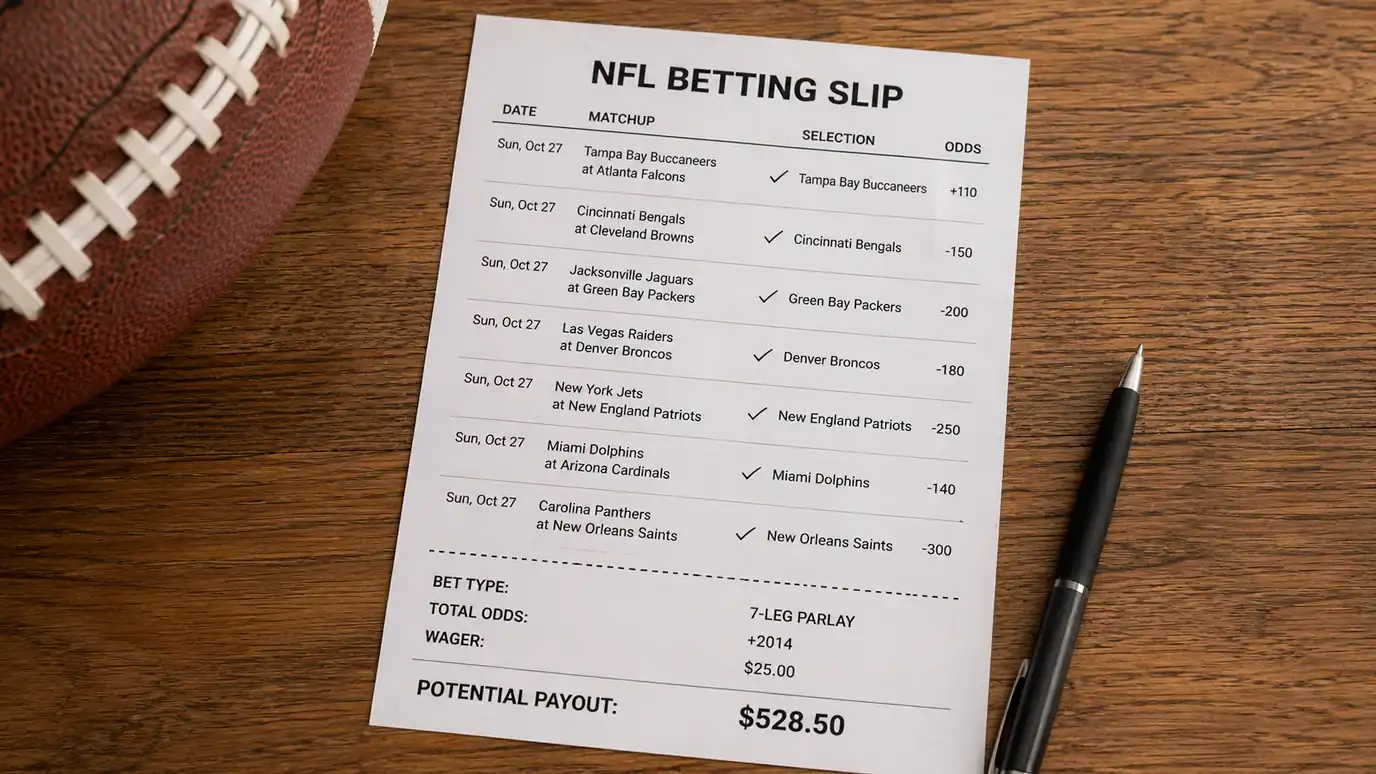
Ask any group of British NFL bettors what they placed last Sunday and at least half will mention an accumulator. The appeal is obvious — small stakes, big potential returns, the dopamine hit of watching legs land one by one. In American terminology this is a parlay: two or more selections combined into a single bet where every leg must win for the wager to pay out.
The maths is straightforward. Each selection’s odds multiply together. A three-leg acca with each leg at evens (1/1) pays 7/1 — your original stake times eight. Add a fourth leg at the same price and you are at 15/1. The compounding effect is what makes accumulators seductive and what makes them structurally difficult to beat over time.
Here is why. If each leg has a true probability of 50%, a four-leg acca has a 6.25% chance of landing. The bookmaker’s margin compounds too — each leg carries its own overround, and by the time you stack four or five of them, the cumulative edge against you is substantial. I am not saying accumulators are never worth placing. I am saying they require a different mental framework than singles.
The framework I use: parlays are for correlated outcomes and for situations where the upside justifies the risk. Correlated parlays combine selections that logically support each other — backing a team on the spread while also taking the over in a game where that team’s path to covering involves scoring heavily. Not all bookmakers price correlated parlays correctly, and the gap between the true probability and the implied probability is wider than on standard independent-leg accas. This is one of the few structural advantages available to sharp recreational bettors.
UK sportsbooks frequently offer acca insurance (one leg fails, free bet returned) and accumulator boosts (enhanced odds on four-plus-leg accas). These promotions can shift the expected value back toward the bettor — sometimes significantly. The key is reading the terms. An acca insurance offer that requires minimum odds of 1/2 per leg and excludes certain markets is materially different from one with no restrictions. I have seen offers where the effective boost to expected value was north of 8%, and others where it was functionally zero after the conditions were applied. For a deeper look at how to structure multi-leg NFL wagers, the parlay and accumulator guide breaks down leg selection and insurance mechanics in detail.
Proposition (Prop) Bets
Proposition bets — props — are where NFL betting gets genuinely creative. Instead of predicting the game outcome, you are betting on events within the game: how many yards a quarterback throws, whether a specific running back scores a touchdown, which team scores first, how many sacks the defence records. The granularity is extraordinary.
Player props dominate the category. Passing yards, rushing yards, receiving yards, touchdowns, receptions, interceptions — each of these can be set as an over/under line for individual players. A typical player prop might read: “Patrick Mahomes — passing yards: Over 274.5 (10/11) / Under 274.5 (10/11).” You are not guessing whether the Chiefs win or lose. You are assessing one player’s likely statistical output against a specific defence in specific conditions.
This is where preparation pays off more than in any other NFL market. Player props are priced by algorithms that weigh season averages, opponent rankings, and recent form — but algorithms can lag reality. When a team loses its starting cornerback to injury on Wednesday and the props for the opposing receiver are not adjusted until Friday morning, there is a window. I have had some of my best individual results exploiting exactly this kind of information gap, particularly during bye weeks when sportsbook traders are spread thin across a reduced schedule.
Game props cover broader events: total touchdowns in the match, whether both teams score in every quarter, the margin of victory bracket, first scoring play type. These markets tend to be lower-volume and wider-margin than game lines, which makes them both riskier and occasionally more rewarding when you identify a genuine edge.
Then there are novelty props, which peak around the Super Bowl. Length of the national anthem, colour of the Gatorade shower, coin toss result. These are entertainment bets with no analytical edge — the coin toss is literally 50/50, and any price worse than evens is pure bookmaker margin. I include them here for completeness, but I would never recommend building a strategy around them. Super Bowl LIX attracted 68 million American bettors, and the prop markets were a significant driver of that engagement — Macquarie Equity Research noted that same-game parlays and prop bets were a slight positive for sportsbooks even when the main game result went against them. The volume tells you how popular these markets have become.
Futures and Season-Long Markets
Every April, before a single preseason snap has been played, I open a spreadsheet and start logging futures prices. Super Bowl winner. Conference champions. Division winners. MVP. Offensive and Defensive Rookie of the Year. Season win totals for all 32 teams. By the time the regular season kicks off in September, those early prices have shifted — sometimes dramatically — and the value that existed in April has evaporated or migrated to different selections.
Futures are long-term bets on outcomes that will not be settled for weeks or months. The most popular NFL futures market is the Super Bowl outright winner, where you can back any of the 32 teams at odds that reflect their perceived championship probability. In a league where more than 76 million Americans placed bets during the 2024/25 season, futures markets are deep, liquid, and aggressively priced — but they are not efficient, particularly at the fringes.
The structural feature of futures that UK bettors need to understand is the time value of money. When you back a team at 16/1 to win the Super Bowl in April, your stake is locked for eight months. You cannot redeploy that capital. The bookmaker can. This is not a reason to avoid futures — it is a reason to be selective about when and where you enter them.
Season win totals are my preferred futures market because they offer a cleaner analytical framework. The question “Will the Jaguars win more or fewer than 7.5 games?” is more tractable than “Will the Jaguars win the Super Bowl?” You can model strength of schedule, roster changes, coaching adjustments, and divisional competitiveness with reasonable precision. The variance is lower, the sample of outcomes (17 regular-season games) is larger, and the edge, when it exists, is more reliably captured.
MVP and award futures are higher-variance but can be lucrative when the market misprices a breakout candidate. The key is early entry. Once a player starts the season on a tear, their MVP odds compress rapidly and the value disappears. I have had multi-year stretches where my best single-bet ROI came from a pre-season MVP ticket on a player the market underrated.
Cash-out options on futures vary by bookmaker. Some UK sportsbooks allow partial or full cash-out on outright futures once the season is underway, which gives you the flexibility to lock in profit if your selection’s odds have shortened significantly. Others do not. Check before you place the bet — liquidity matters in a market where your capital is committed for months.
Asian Handicap vs Point Spread in NFL
This is a question I get asked constantly by UK bettors who come from a football (soccer) betting background: “Is the NFL point spread basically an Asian handicap?” The short answer is yes, with one important distinction that affects how you should think about each.
Both mechanisms assign a virtual advantage or disadvantage to one side. Both adjust the effective scoreline before settlement. Both exist to create a roughly even-money proposition from an uneven contest. The mechanics overlap almost entirely when the line includes a half-point: Chiefs -3.5 on a point spread settles identically to Chiefs -3.5 on an Asian handicap.
The divergence appears on whole numbers. In Asian handicap betting on football, a line of -1 can result in a push (stake returned) or, depending on the format, a half-win or half-loss via split handicaps (-0.5, -1.5). NFL point spreads handle this differently. American sportsbooks use half-points almost universally to eliminate pushes. When an NFL spread does land on a whole number — say, -3 — and the result matches exactly (a three-point win), the bet pushes and stakes are returned. There is no split-line convention.
For UK bettors who already understand Asian handicaps, the translation to NFL spreads is nearly seamless. The main adjustment is psychological: NFL scores move in irregular increments (touchdowns worth six or seven, field goals worth three, safeties worth two), so the spread numbers and their relationship to common scoring margins carry specific meaning that does not map onto football goals. A -3 spread in the NFL is not the same kind of proposition as a -1 handicap in the Premier League, even though both represent roughly “one scoring play.” Context matters, and the context here is that the number 3 in NFL betting is structurally significant in ways that require its own understanding.
How to Pick the Right Bet Type for Each Game
Knowing the mechanics is table stakes. The real skill — the part that separates bettors who grind out a profit from those who are just entertained — is matching the right bet type to each game’s specific circumstances.
I use a simple decision framework that starts with one question: what is my strongest view on this game? If I believe Team A wins but I am uncertain about the margin, a moneyline bet expresses that view cleanly. If I believe the margin will be large but I am less certain about which team, a spread bet on the favourite captures that view. If I believe the game will be high-scoring regardless of winner, a totals bet is the right vehicle. If I believe a specific player will have an outsized statistical game because of a matchup advantage, a player prop targets that view directly.
The mistake I see most often — and I made it myself for years — is defaulting to spreads for every game. Spreads are the most popular NFL market for a reason: they balance risk and reward neatly. But that popularity means spreads are also the most efficiently priced market. The bookmaker’s best traders and sharpest algorithms are focused on getting the spread right. Alternative markets — totals, props, specific quarter lines — receive less attention, less liquidity, and consequently less pricing pressure. Edges survive longer in quieter markets.
Game context should drive your market selection. A primetime game between two high-powered offences with suspect defences? The totals market is likely to be the most interesting. A divisional rivalry between two evenly matched teams where motivation and familiarity compress the talent gap? The moneyline underdog might offer value that the spread does not. A game where a key player is returning from injury and the market has not fully adjusted? A player prop can isolate that variable.
Combining bet types is also an option. Same-game multis — which bundle spread, total, and prop selections from a single game into one wager — have exploded in popularity. Macquarie Equity Research observed that same-game parlays were a meaningful revenue contributor for sportsbooks during the Super Bowl, which tells you something about how these products are priced. They can be useful when your game thesis involves multiple correlated outcomes, but the compounding margin works against you just as it does in standard accumulators.
The disciplined approach: develop a thesis for each game, identify which market best expresses that thesis, check whether the price reflects fair value, and only then place the bet. Most weeks, this process will tell you to bet on three or four games rather than twelve. That restraint is not a weakness — it is how professionals operate, and it is the single biggest adjustment most recreational bettors need to make.
What is a point spread in NFL betting?
A point spread assigns a margin of victory that the favoured team must cover for a bet on them to win. If the spread is -3.5, the favourite must win by four or more points. The underdog at +3.5 covers if they win outright or lose by three or fewer. Half-points eliminate tied outcomes against the spread.
What is the difference between a parlay and an accumulator?
They are the same bet under different names. A parlay is the American term; an accumulator (acca) is the British term. Both combine two or more selections into a single wager where every leg must win for the bet to pay out. The odds multiply across all legs.
Are NFL prop bets available at UK bookmakers?
Yes. Most major UKGC-licensed sportsbooks offer player props (passing yards, rushing yards, touchdowns) and game props (first scoring play, margin of victory) for NFL regular-season and playoff games. Market depth varies by operator and tends to be deepest for primetime and playoff fixtures.
Can I combine different bet types in one NFL wager?
Yes, through same-game multi or bet builder features offered by most UK sportsbooks. You can combine a point spread selection, a totals pick, and one or more player props from a single game into one bet. Each leg must win for the wager to pay out, and the odds compound accordingly.
Published by the Online Sports Betting nfl team.