NFL Parlay and Accumulator Guide for UK Bettors
 Available in US
There is a reason every sportsbook on the planet promotes accumulators more aggressively than any other bet type: they are enormously profitable — for the bookmaker. I say that not to discourage you from ever placing a parlay, but to frame this entire guide honestly. NFL accumulators can be entertaining, occasionally lucrative, and strategically sound when constructed with discipline. They can also be the fastest way to drain a bankroll if you treat them as lottery tickets.
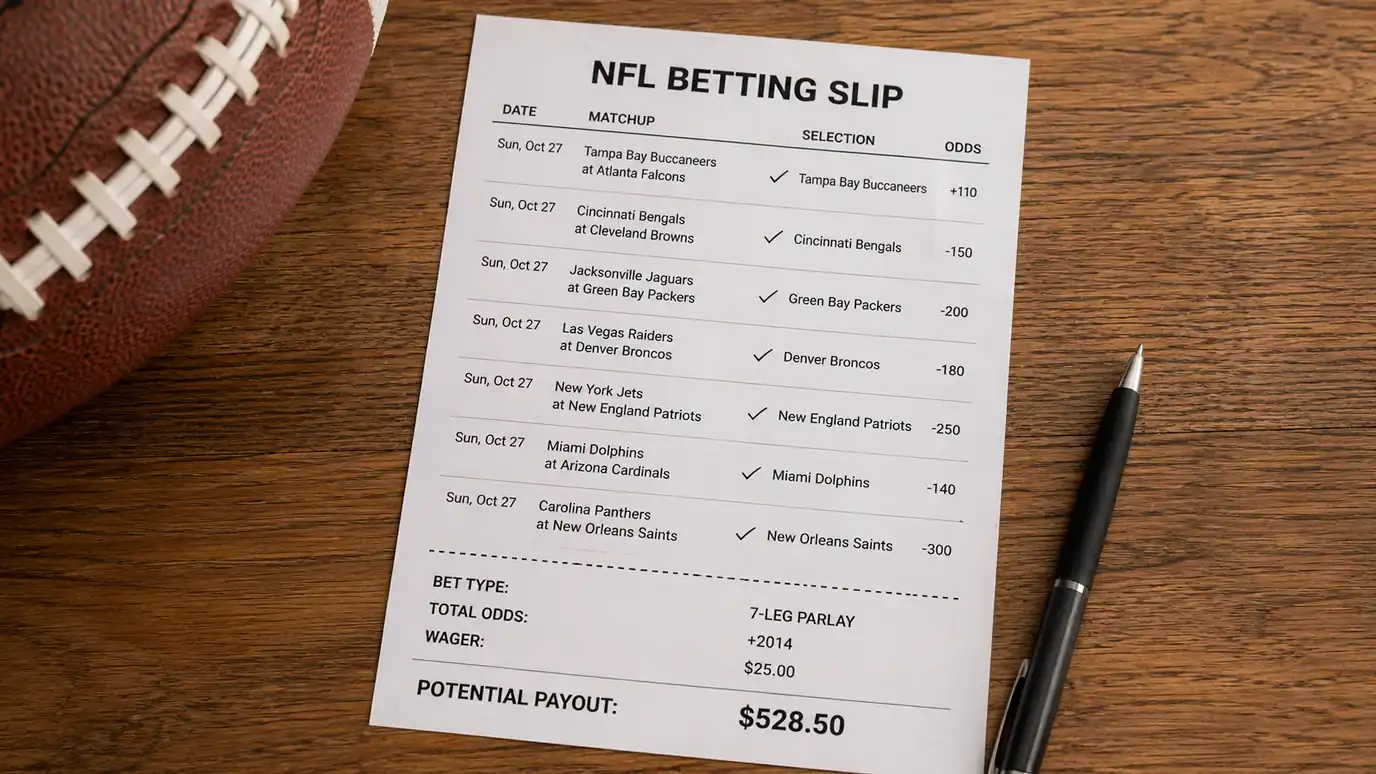
In the UK, we call them accumulators or accas. In the US, they are parlays. The mechanics are identical: you combine two or more selections into a single bet, and every leg must win for the bet to pay out. The appeal is the compounding odds — a four-leg acca at evens on each leg pays 15/1 instead of the 1/1 you would get on each individual bet. The catch is that your probability of winning drops with every leg you add.
How NFL Parlays and Accumulators Work
Last December I built a three-leg NFL Sunday acca that looked rock-solid on paper: Ravens moneyline, Lions to cover -3.5, and the Bengals-Steelers over 44.5. Two legs landed comfortably. The third — the total — fell short by a single field goal. That is the accumulator experience in miniature: close, frustrating, and a useful reminder that “nearly right” pays exactly the same as “completely wrong.”
The mechanics are simple. You select two or more outcomes across different NFL games (or, with same-game multis, within a single game). The sportsbook multiplies the decimal odds of each selection together to produce a combined price. Your stake is applied to that combined price, and you receive the payout only if every selection wins.
A worked example: you back three NFL moneyline favourites, each priced at 1.50 decimal (1/2 fractional). Individually, each bet returns 1.50 times your stake. Combined as a treble, the price is 1.50 x 1.50 x 1.50 = 3.375. A ten-pound stake returns 33.75 if all three win. The implied probability of each leg at 1.50 is 66.7%. The combined probability (assuming independence) is 0.667 x 0.667 x 0.667 = 29.6%. You have gone from a two-in-three chance on each game to less than a one-in-three chance of the acca landing.
This is the mathematical reality that the headline payout obscures. Each additional leg multiplies both the potential return and the probability of failure. A five-leg acca of even-money selections pays 31/1 but has a 3.1% true probability of winning. A ten-leg version pays over 1,000/1 with a 0.1% chance. The sportsbook does not need to beat you on any individual selection — the structure of the bet does it for them.
Calculating Parlay Payouts
If you are placing accas at a UK sportsbook, the simplest calculation uses decimal odds. Multiply all legs, multiply by stake. But fractional odds require an extra step, and getting it wrong is a common source of confusion.
With fractional odds, convert each selection to decimal first: divide the numerator by the denominator and add one. So 5/4 becomes (5/4) + 1 = 2.25. Then multiply all decimal equivalents together. For a double at 5/4 and 6/5: 2.25 x 2.20 = 4.95 combined decimal. A five-pound stake returns 24.75.
Most sportsbook apps do this calculation automatically on the bet slip, so you rarely need to do it manually. Where manual calculation matters is when you are evaluating potential accas before adding them to the slip — comparing two possible four-leg combinations to see which offers better value. I keep a simple spreadsheet for this during the NFL season, logging the implied probability of each leg against my own assessment. If any single leg does not clear my minimum value threshold, it does not go into the acca, regardless of how appealing the combined price looks.
Accumulator Insurance and Boosts at UK Sportsbooks
Accumulator insurance — where the sportsbook refunds your stake (usually as a free bet) if exactly one leg of your acca loses — is one of the most marketed promotions in UK sports betting. 68% of surveyed British bettors in early 2026 said they plan to increase betting activity across the sporting calendar, and operators respond by sweetening acca offers to attract that volume.
The typical terms: minimum four or five legs, minimum odds per leg (often 1/5 or 1/4), and the refund comes as a free bet with its own wagering requirements rather than cash. Some operators offer acca boosts instead — percentage increases to the combined odds if the acca wins, scaling with the number of legs. A five-leg acca might get a 10% boost; ten legs might get 50%.
Are these offers genuinely valuable? Sometimes. The insurance effectively reduces your downside on accas where you are already close to breakeven. If your four-leg acca has a 15% true win probability and the insurance covers one losing leg, your effective win rate increases modestly. But the free-bet refund is worth less than cash (typically 70-80% of face value due to wagering requirements), and the minimum-leg requirement pushes you toward longer accas where the house edge compounds further.
My approach: I use acca insurance when I have four or five selections I would bet individually anyway. I do not add weak legs to reach an insurance threshold. That distinction is the difference between using a promotion strategically and being used by it.
Parlay Strategy: Correlation and Leg Selection
After Super Bowl LIX, Macquarie Equity Research observed that same-game parlays and prop bets were a slight positive for sportsbooks despite the game result being their worst-case scenario on the moneyline. That note tells you something important: the structure of parlays tends to favour the house even when individual outcomes go against them.
To push back against that structural disadvantage, you need to think about correlation. Two events are correlated when the outcome of one makes the outcome of the other more or less likely. In NFL betting, “team wins” and “team covers the spread” are highly correlated — obviously. But “team wins” and “game goes over the total” can also be correlated depending on the matchup. A team trailing early passes more, inflating total yardage and points. Understanding these relationships is where same-game multi strategy becomes genuinely interesting.
For cross-game parlays, correlation is weaker but not zero. Weather conditions affecting multiple outdoor games on the same Sunday can create correlated unders. Divisional rivalry weeks tend to produce tighter, lower-scoring games across the board. Identifying these patterns does not guarantee acca wins, but it gives you a structural edge over random leg selection.
Three principles I apply to every NFL acca I build. First, never include a leg I would not bet as a single. If the selection is not valuable on its own, adding it to a parlay does not create value — it dilutes it. Second, cap the legs. I rarely go beyond four, and almost never beyond five. Every additional leg costs you expected value, and the payout increase is not linear with the probability decrease. Third, size the stake appropriately. Accas are inherently high-variance, so they should represent a small fraction of your weekly NFL betting budget — I keep mine below 10% of total weekly stakes.
The most profitable NFL accas I have placed over nine seasons have been short — two or three legs — at prices where I identified genuine value on each selection independently. The biggest payouts came from five or six-leg accas that landed on luck as much as analysis. I remember the wins vividly. I also remember the dozens of near-misses that preceded them, and the net cost of those near-misses exceeded the eventual win more often than not.
How do NFL parlays and accumulators differ from single bets?
A single bet is one selection on one outcome. A parlay or accumulator combines two or more selections into one bet where all legs must win for the bet to pay out. The combined odds are higher than any individual leg, but the probability of winning decreases with each leg added. A three-leg acca of even-money selections has roughly a 12.5% win probability versus 50% for each leg individually.
What is acca insurance and which UK bookmakers offer it for NFL?
Acca insurance refunds your stake as a free bet if exactly one leg of your accumulator loses. Most major UK sportsbooks offer it with conditions: typically a minimum of four or five legs, minimum odds per selection, and the refund comes as a free bet rather than cash. The promotion is widely available during NFL season from the largest UKGC-licensed operators.
Prepared by the Online Sports Betting nfl editorial staff.