NFL Odds UK: Fractional, Decimal and American Formats Compared
 Available in US
I once watched a fellow punter at a London NFL watch party celebrate a “great price” on the Eagles at +150, convinced he was getting 150/1. He was not. He was getting 3/2 in fractional terms — a solid price, but not quite the retirement fund he was imagining. The confusion between odds formats is one of the most expensive knowledge gaps in NFL betting, and it is entirely avoidable once you understand what each number actually represents.
47% of British gamblers prefer sports betting over every other form of gambling except the lottery, yet most UK sportsbooks default to fractional odds that were designed for horse racing. NFL content from the US, meanwhile, uses American odds almost exclusively. If you are consuming team news, injury analysis, and line movement data from American sources — and you should be — you need fluency in all three systems. This guide gives you that.
Fractional, Decimal, and American: Side by Side
Three formats, one reality. Every odds format expresses the same underlying probability and potential payout — they are just different languages for the same maths. Let me make this concrete with an example from a typical NFL Sunday.
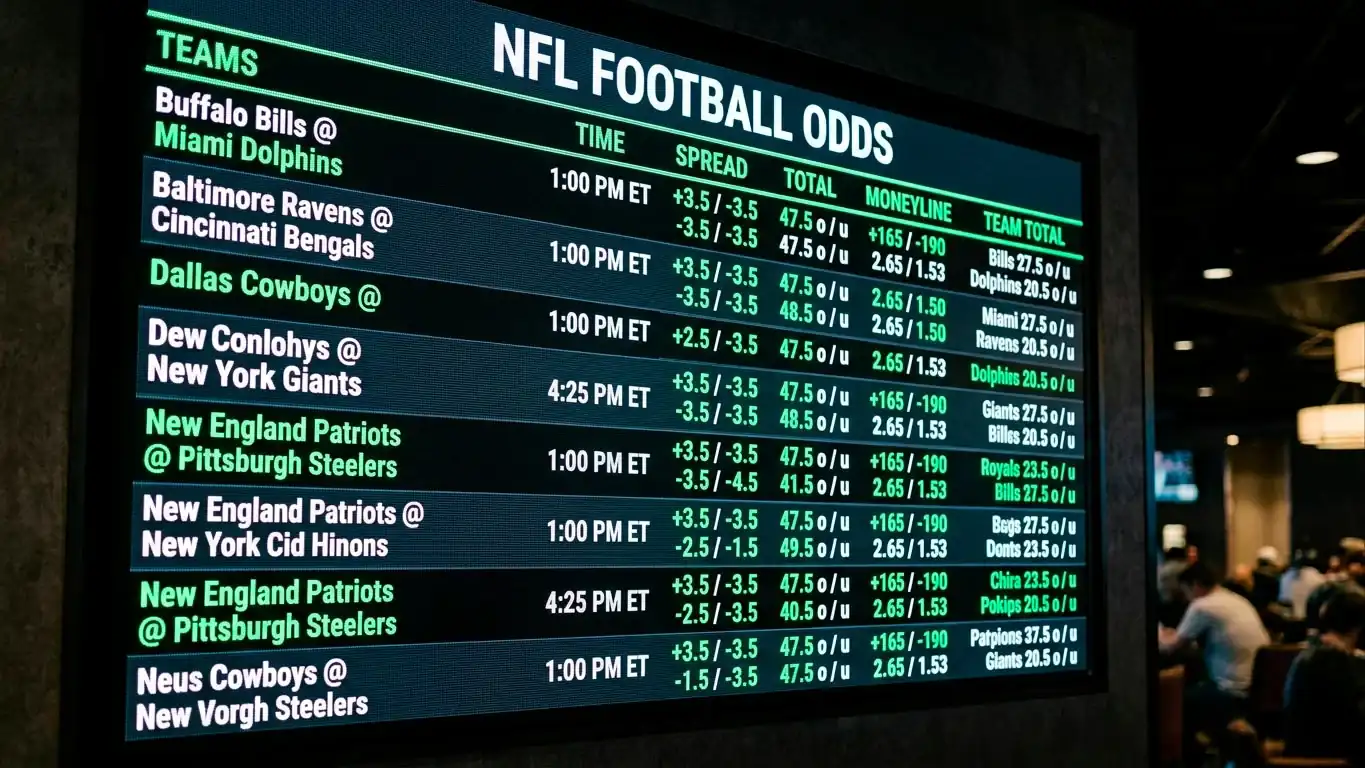
Suppose the Buffalo Bills are favoured on the moneyline against the Miami Dolphins. A UK sportsbook might price them at 4/7 (fractional), an international platform at 1.57 (decimal), and an American sportsbook at -175 (American). All three prices mean the same thing: stake seven pounds to profit four, or a total return of 1.57 times your stake, or lay 175 dollars to win 100.
Fractional odds are the UK standard. The number on the left is your profit; the number on the right is your stake. At 4/7, you profit four pounds for every seven staked. At 2/1, you profit two for every one. At 1/1 (evens), profit equals stake. The strength of fractional odds is instant recognition for anyone raised on UK betting — you see 10/1 and you know it is a long shot paying handsomely.
Decimal odds are dominant in continental Europe and increasingly common at UK sportsbooks as a settings option. The number represents your total return per unit staked, including your original stake. So 1.57 means a one-pound bet returns 1.57 (your pound back plus 57p profit). Decimal odds make accumulator calculations trivial: multiply all the decimal prices together and multiply by your stake. Done.
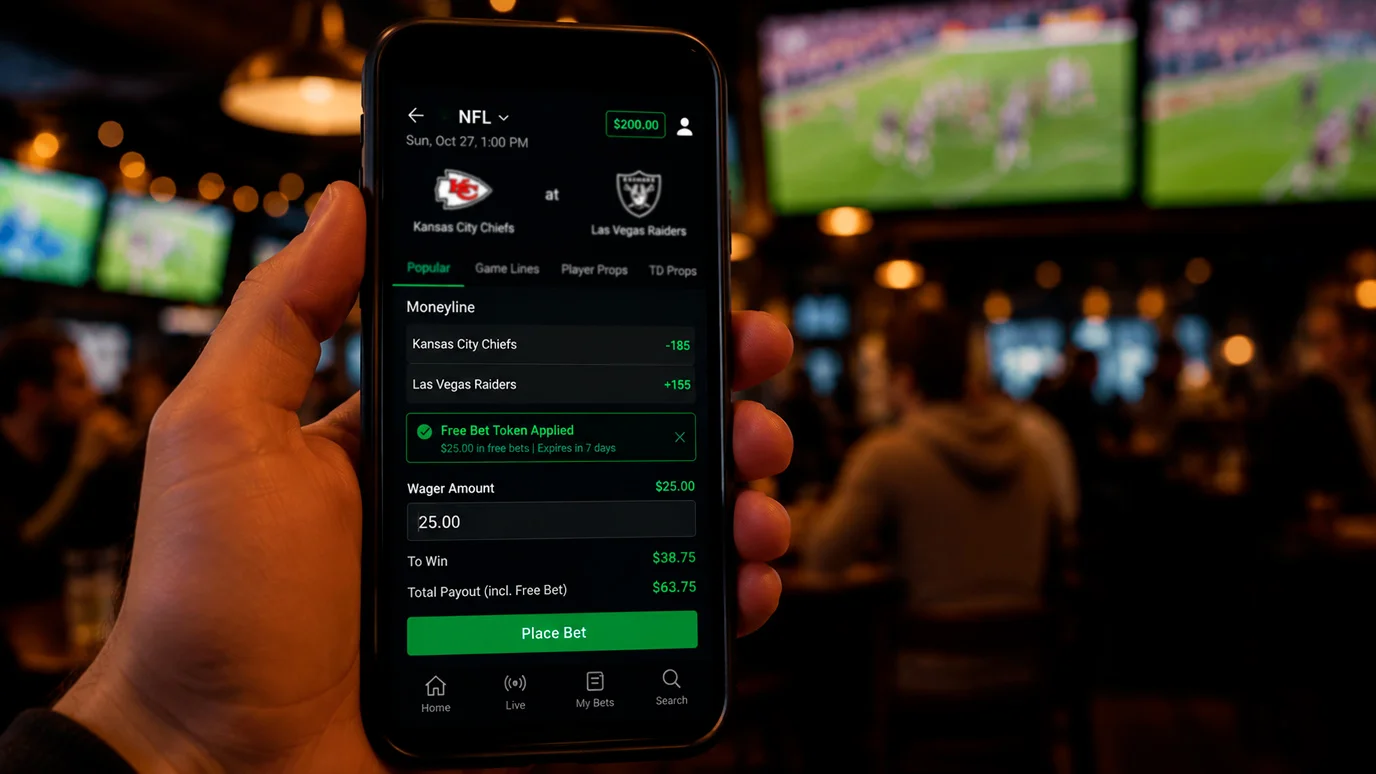
American odds split into two halves. Positive numbers (+150) tell you the profit on a 100-unit stake: bet 100, profit 150. Negative numbers (-175) tell you how much you must stake to profit 100: bet 175, profit 100. The minus sign means favourite; the plus sign means underdog. Every piece of NFL analysis from ESPN, The Athletic, or social media uses this format, so learning to read it at a glance saves you constant mental conversion.
The conversion formulas are straightforward. From fractional (a/b) to decimal: (a/b) + 1. From decimal to American: if the decimal is 2.00 or above, American = (decimal — 1) x 100; if below 2.00, American = -100 / (decimal — 1). You do not need to memorise these — most sportsbooks let you toggle between formats with a single click. But understanding the logic behind them means you can instantly assess value when reading US-sourced NFL analysis.
Spotting Value in NFL Odds
A price is only “good” relative to the actual probability of the outcome. This is where most casual bettors go wrong — they see short odds and assume the favourite is a lock, or long odds and assume the underdog has no chance. Neither assumption is reliable in the NFL, where live and in-play betting now accounts for over 62% of online betting revenue precisely because outcomes are volatile.
Value exists when the implied probability of the odds is lower than your assessed true probability. Implied probability from fractional odds: b / (a + b). At 4/7, that is 7 / (4 + 7) = 63.6%. If you believe the Bills genuinely win that game 70% of the time, you have value. If you think it is closer to 60%, you do not.
The NFL is particularly fertile ground for value hunting because the betting public — especially in the US market, which drives opening lines — has well-documented biases. Favourites are overbet on the moneyline. Overs are more popular than unders. Marquee teams attract disproportionate action regardless of the matchup. These biases create systematic pricing inefficiencies that move across to UK markets.
My approach is to convert every NFL line I am evaluating into implied probability first, then compare it against my own model or assessment. This strips away the distraction of the odds format and forces you to think in terms of likelihood rather than potential payout. A +300 underdog sounds exciting. A team with a 25% win probability (which is what +300 implies before vig) sounds like exactly what it is: a three-in-four chance of losing your stake.
Bookmaker Margins on NFL Markets
Every set of odds includes the bookmaker’s margin — the mathematical edge built into the price. If a fair coin flip should be priced at evens (2.00 decimal) on both sides, a bookmaker might price both sides at 1.91, creating a combined implied probability above 100%. That excess is the margin, and it comes directly out of your expected returns.
On NFL moneyline markets at major UK sportsbooks, margins typically range from 4% to 7% on standard games. Point spread markets, because they are designed to attract roughly equal action on both sides, tend to be tighter — often 3% to 5%. Totals markets sit somewhere in between. Props and exotics carry wider margins, frequently 8% to 12%, because the bookmaker has less data to price them precisely and less competitive pressure.
Why does this matter? Because over hundreds of bets, margin is the silent tax on your bankroll. A bettor who consistently bets at 4% margin versus one betting at 7% margin will have dramatically different long-term results, even if their selection accuracy is identical. Comparing odds across three or four sportsbooks before placing any NFL bet is not obsessive — it is basic financial hygiene. A dedicated understanding of NFL betting types also helps you choose markets where margins tend to be thinnest.
I track margins on every NFL bet I analyse. Over a full season, the difference between the tightest and widest-margin operator on the same market can represent two to three percentage points of implied probability. On a forty-pound stake, that is the difference between a return of 76 and 72 — small on one bet, significant across a season of weekly wagers.
Why do NFL odds look different on US and UK betting sites?
US sites default to American odds format (+150, -200) while UK sites use fractional (3/2, 1/2) or decimal (2.50, 1.50). All three formats express the same underlying price and probability — they are just different notation systems. Most UK sportsbooks let you switch between formats in your account settings.
How do I calculate implied probability from fractional NFL odds?
Divide the right-hand number by the sum of both numbers. For 4/7 odds: 7 divided by (4 + 7) = 63.6% implied probability. For 5/2 odds: 2 divided by (5 + 2) = 28.6%. This tells you the minimum win rate you need at those odds to break even before accounting for the bookmaker margin.
Written by the editors at Online Sports Betting nfl.